

By Alex MacLagan, Loan Officer | NMLS #1912744
A DSCR cash out refinance can help eligible real estate investors access rental property equity without qualifying through personal employment income. A no seasoning cash out refinance DSCR loan may also allow you to refinance without a minimum ownership waiting period, through lenders offering that option. Property value, acceptable rent, credit, occupancy, and the lender’s guidelines still determine what is possible.
At MacLagan Home Loans, I work with lending partners that offer no seasoning options. For an investor who recently purchased or improved a rental, that can create an opportunity to recover capital sooner. My first question is where that money will go and how the new debt will affect the portfolio.
Can you get a no seasoning cash out refinance DSCR loan?
Yes. Eligible investors can access a no seasoning cash out refinance DSCR loan through certain programs. No seasoning refers to the ownership waiting period; it does not mean an appraisal, underwriting, title review, or other closing requirements disappear.
For example, Champions Funding’s published no seasoning program information describes cash out without a six or twelve month wait and use of the current appraised value. It also identifies a restriction for recently listed properties: the lower of the listing price or appraised value applies. This is a program example, subject to eligibility and current guidelines.
The practical opportunity is choosing a program around your purchase date and investment plan instead of assuming every investor must wait six months. Tell me when you acquired the property, how you financed it, whether it is rented, and what improvements you completed. Those details determine which options deserve a closer look.
A program without an ownership waiting period should not be interpreted as a promise to close the day after purchase. There is still a transaction to document, underwrite, and fund.
Ownership seasoning and the value a lender accepts
Ownership seasoning and the value a lender accepts are separate questions. A lender may permit an early refinance while limiting the loan based on acquisition costs, documented improvements, occupancy, or recent listing history.
The HomeXpress InvestorX guidelines dated September 11, 2026 illustrate why this distinction matters. Their property seasoning section allows cash out within six months of purchase at a maximum 75% loan to value, subject to other requirements. A vacant property in that window has a loan amount restriction tied to purchase price, documented improvements, and new loan fees. An all cash acquisition within six months refers to separate delayed financing rules.
That is why I review the actual scenario before relying on a headline program feature. Keep the purchase settlement statement, renovation invoices, proof of payment, and lease information. Even when a current appraisal is available, the lender decides the eligible value and financing limits under its program.
I also compare whether waiting would improve the available choices. In my experience, reaching six months of ownership can open additional lenders. An earlier refinance may be useful, but the timing should make sense after comparing costs, proceeds, and the next investment opportunity.
How much cash can you receive from a DSCR refinance?
Your estimated net proceeds equal the new loan amount minus existing liens being paid off, transaction costs, any applicable payoff penalty, and other closing deductions. Equity alone does not determine the check you receive because rental income and other underwriting limits can reduce the approved loan amount.
Consider this hypothetical example. Assume the lender accepts a $500,000 value and approves a $375,000 loan, representing 75% loan to value. This percentage is an illustration, not a promise that every investor qualifies for it.
| Item | Hypothetical amount |
|---|---|
| Accepted property value | $500,000 |
| New loan amount | $375,000 |
| Existing mortgage payoff | $260,000 |
| Closing costs and other deductions | $12,000 |
| Existing loan prepayment penalty | $8,000 |
| Estimated net cash to borrower | $95,000 |
The calculation is $375,000 less $260,000, $12,000, and $8,000, leaving $95,000. Actual payoff interest, escrow funding, lender fees, and settlement adjustments can change that result. Do not count a future escrow refund as cash available at this closing.
Before comparing offers, ask for the estimated net proceeds and the new payment together. A higher loan amount may produce more cash today while leaving less breathing room every month.
Why can an appraisal change the cash out amount so much?
An appraisal affects the property value used in the lender’s loan to value calculation. A lower accepted value can reduce borrowing capacity even when you have renovated the building and believe comparable properties support a higher number.
One investor I worked with owned a four unit building on Chicago’s South Side. He had purchased it for approximately $450,000 three to four years earlier and subsequently renovated all four units. The initial appraisal through one lender came in at $430,000.
I questioned whether that result adequately reflected the property and local comparable sales. We changed lenders, and a new appraisal came in at $580,000. This is an anonymized example from my experience, shared with permission. The two reports reached different conclusions; the second number does not establish that every similar property deserves the same valuation.
For scale, applying an assumed 75% loan to value to those two figures produces a $112,500 difference in theoretical loan capacity. That is a mathematical illustration, not the actual cash out result for this borrower. Rental income, payoff amounts, costs, and other limits still apply.
My role is to help identify supported concerns and evaluate the available process, including a reconsideration of value where appropriate. Changing lenders can add expense and time, and another appraisal can be lower, unchanged, or higher. A broker cannot promise or direct an appraised value.
How do existing rents affect DSCR pricing and proceeds?
Rents affect the income the lender can use to support the proposed payment. When acceptable rental income is low relative to that payment, the DSCR falls, which can affect eligibility, pricing, and how much debt the property supports.
For many residential DSCR programs, the calculation compares qualifying monthly rent with principal, interest, property taxes, insurance, and applicable association dues. Champions Funding’s DSCR explanation also shows that the rent accepted depends on its lease and appraisal rules. Other programs can calculate income or payments differently.
For example, $3,750 of qualifying rent divided by a $3,000 qualifying payment produces a 1.25 DSCR. At $3,000 of rent, the same payment produces 1.00. This is a ratio illustration, not a payment quote.
Among lenders I work with, I commonly see more favorable pricing at 1.25 or above, another pricing band from 1.00 through 1.24, and more expensive options below 1.00. Those are patterns from my lending experience, not universal rate tiers. Credit, leverage, property type, and prepayment terms also influence the quote.
Do not assume an occupied unit can qualify using a higher hypothetical market rent. Review existing leases and the program’s requirements. Any rent changes must respect the lease and applicable requirements. Our guide to calculating DSCR for a rental property explains the calculation in more detail.
When should you keep your current first mortgage?
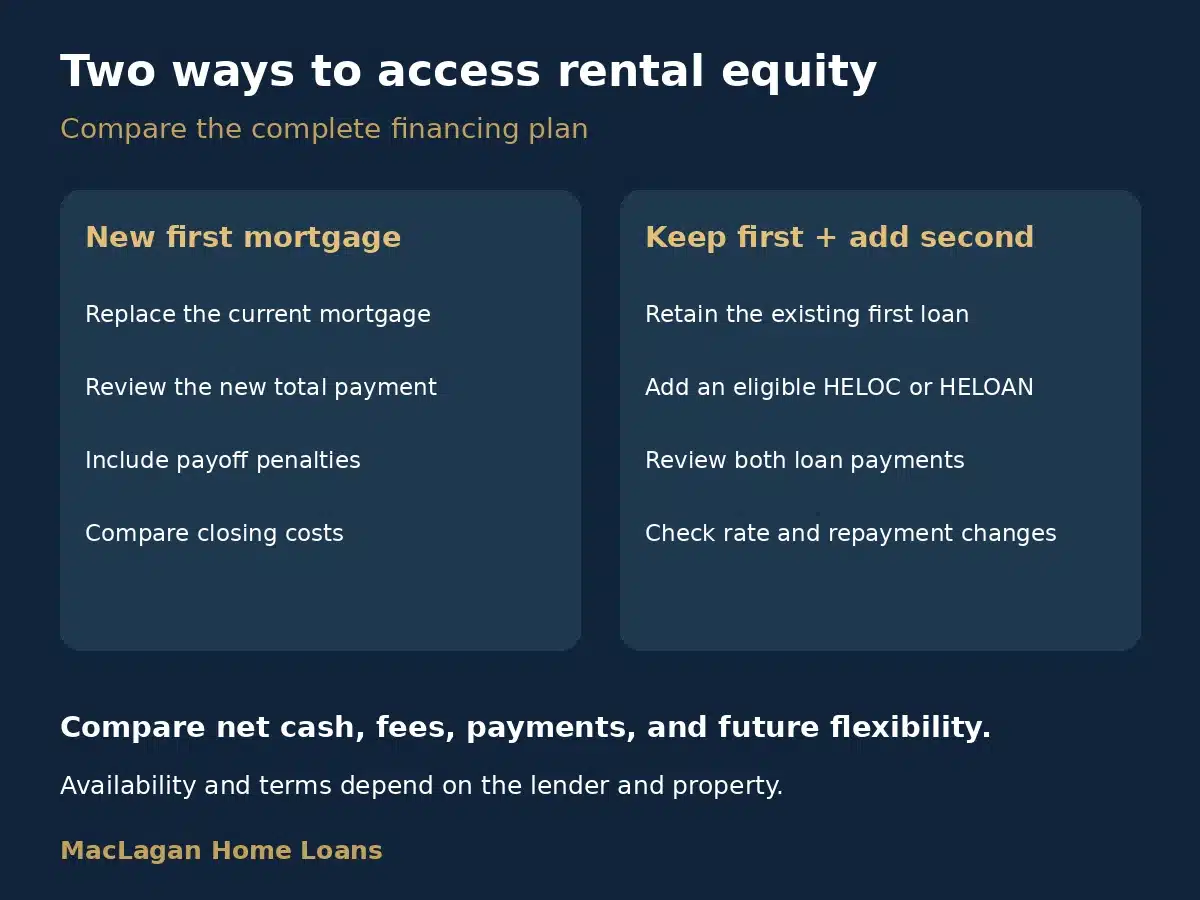
Keeping the existing mortgage may make sense when replacing a low rate first mortgage would reduce cash flow too much. I compare the proposed refinance with eligible DSCR HELOC or HELOAN options, including the combined payments, fees, and repayment terms.
A HELOC provides a revolving credit line under its agreement, while a HELOAN generally provides a lump sum with a repayment schedule. Availability for rental properties and the permitted lien position vary by lender. A second lien is not automatically cheaper simply because it preserves the first loan.
A balance weighted interest rate can help frame the comparison, but it is not an APR or a complete cost analysis. I also compare variable rate exposure, repayment periods, closing costs, and the payment after any interest only period ends. Your existing DSCR prepayment penalty belongs in that comparison too.
I consider replacing a lower rate mortgage when the intended investment can justify the added cost across the portfolio. That means evaluating realistic operating expenses and reserves for both properties, including a slower lease up or renovation. Projected income from the next purchase is not guaranteed income available today.
Reusing equity for the next rental purchase
One strategy I discuss with investors is using an eligible investment property HELOC to fund a purchase and improvements, then refinancing the completed rental into a long term DSCR loan. If the proceeds are sufficient, the investor can repay the line and potentially use it again during its available draw period.
This approach requires planning the refinance before committing to the acquisition. I want to know the expected completed value, renovation budget, acceptable rents, financing costs, and backup source of repayment if the refinance produces less cash than expected.
Recovering all initial cash can make a simple cash on cash percentage undefined because no original cash remains in that calculation. It does not make the investment risk free or create unlimited returns. Debt, ongoing expenses, and exposure to both properties remain. A line also stays subject to its credit agreement and continued availability.
Five steps to review your DSCR cash out options
- Gather the property facts. Provide the purchase date, settlement statement, current mortgage statement, leases, insurance, taxes, and renovation records.
- Identify the goal. Explain how much cash you need, its intended business use, and your timing for the next transaction.
- Check program eligibility. Confirm ownership seasoning, acceptable value, occupancy rules, loan limits, and required reserves before relying on projected proceeds.
- Compare the whole transaction. Review net cash, monthly payments, closing costs, existing payoff penalties, and the proposed loan’s prepayment terms.
- Test a conservative outcome. Recalculate with lower accepted rent or value and a larger expense budget, then decide whether to proceed, reduce the request, or wait.
Frequently asked questions
Does no seasoning mean guaranteed cash out approval?
No. It removes an ownership waiting period under the applicable program. The borrower and property must still meet the lender’s credit, valuation, rental income, title, and other requirements.
Can I refinance a property I bought entirely with cash?
Potentially. Some programs apply separate delayed financing requirements to a recent all cash purchase. Provide the purchase settlement statement and source of acquisition funds so the lender can determine the applicable rules.
Can a DSCR cash out refinance work below a 1.00 ratio?
Some lending partners offer options below 1.00 or with no minimum ratio. Availability and pricing depend on the program and borrower profile. Approval does not establish that the rental will cover all ownership expenses.
Does a higher appraisal guarantee more cash at closing?
No. A higher accepted value can improve loan to value capacity, but qualifying rent, credit, program limits, payoffs, and closing costs can still restrict net proceeds.
What should I send for an initial cash out review?
Start with the property address, purchase date and price, estimated value, current loan balance and rate, monthly rents, taxes, insurance, and the amount of cash you want. Include any known prepayment penalty and details of recent renovations.
Review Your DSCR Cash Out Options
Want to access rental property equity or explore a no seasoning cash out refinance DSCR loan? MacLagan Home Loans can review your property, current financing, and next investment together. We can compare a new first mortgage with available equity financing options and estimate the cash and payment tradeoffs before you commit.
No SSN required. Zero impact to credit. Your information is never sold.
Educational information, not a commitment to lend. Programs, pricing, and availability can change. All loans are subject to eligibility, underwriting, and applicable requirements. Illustrations are not loan quotes or promised results.

ABOUT THE AUTHOR
Alex MacLagan, Loan Officer
NMLS #1912744
Alex MacLagan is a mortgage loan officer with MacLagan Home Loans, licensed in Illinois, Wisconsin, Arizona, and Minnesota. Known to his clients as “Alex The Mortgage Doctor,” he works with first time buyers, move up buyers, self employed business owners, and real estate investors across Chicagoland and the north and northwest suburbs. Before lending, Alex spent years on the investing side of real estate with hands on experience across 100+ flips and rental properties, which shapes how he structures financing for clients today. When he’s not writing about mortgages or working with clients, you’ll find him with his fiancée and their dog.