
By Alex MacLagan, Loan Officer | NMLS #1912744
Choosing between DSCR and conventional loans for investment properties starts with how you qualify, how you want to hold title, and how long you expect to keep the mortgage. Conventional financing deserves a close look when your documented income supports the loan and avoiding a prepayment penalty is important. DSCR financing can be useful when qualifying through rental income or closing in an eligible business entity better fits your investment plan.
At MacLagan Home Loans, I compare the financing with the investor’s plans for the property. The rate matters, but so do points, reserves, documentation, and the cost of refinancing or selling earlier than expected. This guide focuses on rental investments that you will not occupy.
What is the main difference between DSCR and conventional investment loans?
Conventional investment financing evaluates the borrower’s qualifying income and debt obligations. DSCR financing evaluates rental income against the property’s qualifying payment under the lender’s program, without the same personal income qualification process.
DSCR stands for debt service coverage ratio. On many residential programs, it compares qualifying monthly rent with principal, interest, taxes, insurance, and applicable association dues. The exact treatment of rent and payments depends on the program. Our guide to calculating DSCR for a rental property explains the mechanics.
A DSCR loan still requires underwriting. The lender reviews such factors as credit, available funds, property condition, valuation, and ownership documents. “No personal income documentation” does not mean no documentation or guaranteed approval.
| Decision | Conventional investment financing | DSCR financing |
|---|---|---|
| Income review | Qualifying borrower income and debts | Property rental income under program rules |
| Ownership | Generally individual borrowers, with permitted exceptions | Eligible business entities available through certain lenders |
| Early payoff | Review conventional options without a penalty | Compare available penalty terms and pricing |
| Available cash | Down payment, costs, and applicable reserves | Down payment, costs, and program specific reserves |
| Best comparison | Qualification and complete borrowing cost | Qualification and complete borrowing cost |
When I recommend comparing conventional financing first
I often recommend comparing conventional financing first when the investor qualifies and does not want a prepayment penalty. In my experience, removing the penalty from a DSCR option can increase its rate enough to make an available conventional offer more attractive.
That is a pricing observation from the loans I review, not a promise that conventional will always be cheaper. Compare actual quotes for the same property, loan amount, and timing. A quote with more points is not directly comparable to one with fewer upfront charges simply because its rate is lower.
The investor’s exit plan matters here. Someone expecting to refinance after improving the property may value flexibility differently from someone planning to keep the same mortgage for years. I ask about the mortgage timeline separately from the property timeline because an investor can keep the rental while replacing its financing.
Before choosing, review the payoff provisions in the actual loan documents. Our article on DSCR prepayment penalties explains common structures and the questions to ask.
When would I recommend DSCR instead?
I consider DSCR when an investor wants eligible business entity ownership or when the income available for conventional qualification does not support the requested loan. Both issues can make the ownership and underwriting structure more important than a rate comparison alone.
Many investors I work with claim substantial legitimate business and rental deductions. Their qualifying income may look different from the cash they believe the properties generate. That can affect conventional debt to income qualification and make rental based financing worth exploring.
However, qualifying income is not simply the taxable income figure copied from a return. Conventional analysis can include permitted adjustments. Before assuming tax deductions prevent approval, have the returns and rental schedules reviewed under the applicable guidelines. Fannie Mae’s self employed borrower guidance describes the need to evaluate income and business financial information.
DSCR also has a limit that matters: a property with substantial equity or strong potential may still have insufficient acceptable rent for the desired loan terms. The program’s rent calculation, leverage limits, and other requirements remain part of the decision.
Can you close an investment property loan in an LLC?
Eligible DSCR programs can allow an LLC or another approved business entity to hold title. Standard conventional agency financing generally involves individual borrowers, subject to permitted exceptions, so you should confirm ownership plans before selecting a program.
Fannie Mae’s borrower eligibility guidance establishes individual borrowers as the general rule and identifies exceptions. Do not assume an ordinary LLC purchase fits one of those exceptions, or that a later title transfer is automatically permitted.
For DSCR, ask which entity documents and guarantees are required. Entity ownership does not by itself establish that a loan is nonrecourse or eliminate personal liability under a guarantee. Your attorney can help determine the ownership structure; the lender determines what its program accepts.
Why can reserves change which loan is practical?
Reserves are eligible assets remaining available after closing, separate from the money spent on the down payment and closing costs. A borrower can have enough cash to close and still need additional eligible assets to satisfy reserve requirements.
Under Fannie Mae’s reserve rules, an investment property transaction through Desktop Underwriter generally requires six months of reserves for the subject property. Additional reserves can apply when the borrower has other financed properties.
For applicable additional properties, the calculation uses a percentage of eligible aggregate unpaid mortgage balances: 2% for one through four financed properties, 4% for five through six, and 6% for seven through ten. The calculation excludes specified properties, including the subject property and principal residence. Other exclusions and underwriting requirements apply, so the property count and balance worksheet need individual review.
DSCR lenders have their own reserve rules. Do not assume DSCR requires less money or that every bank or retirement account counts at its full balance. I compare the actual asset requirement for both options before recommending a loan.
Does conventional financing stop at ten loans?
The relevant Fannie Mae rule counts financed properties, not just conventional loans. For an investment property or second home transaction through Desktop Underwriter, the stated maximum is ten financed properties, with specific counting rules and exclusions.
Fannie Mae’s financed property policy generally counts residential properties with one through four units where the borrower is personally obligated. A financed principal residence counts, and multiple mortgages on one property do not turn it into multiple properties. Buildings with more than four units are among the excluded property types.
This is not a universal cap on how many properties an investor can own. DSCR lenders may offer additional routes, but their individual exposure and portfolio rules still need review. Bring a complete property schedule rather than assuming a loan’s label determines whether it counts.
Do bonuses, commissions, and overtime always require two years?
No. Under Fannie Mae’s guidance, a two year history is recommended for bonus, commission, and overtime income. A shorter history of at least twelve months may be acceptable when positive factors support it. The lender must still document and evaluate the income.
The variable income guidelines also require a review of the earnings trend. A strong recent paycheck does not automatically establish the qualifying monthly amount.
This is one reason I discuss income documentation early. If the investor needs variable income to qualify, gathering employment verification and earnings records can affect the process. DSCR may offer a different qualification route, but that does not establish that every DSCR transaction closes faster. Appraisal, title, leases, and entity documents can also cause delays.
Compare points against your expected mortgage timeline
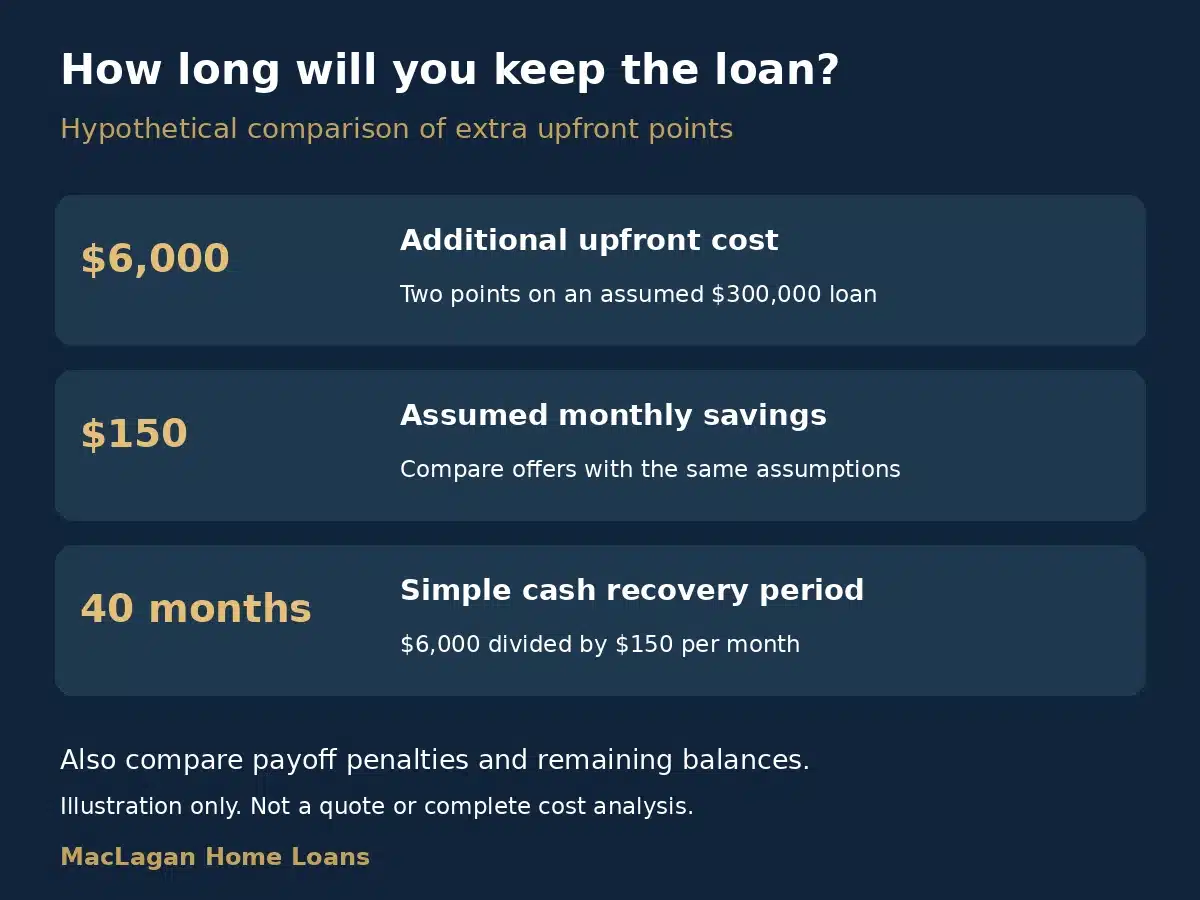
Points can materially increase the amount you bring to closing. One point equals 1% of the loan amount. On a hypothetical $300,000 loan, two points equal $6,000, before other closing costs and prepaid items.
Suppose one option costs $6,000 more upfront and saves $150 each month. A simple cash recovery calculation is $6,000 divided by $150, or forty months. After twenty four months, the payment savings would total $3,600, leaving $2,400 of the extra upfront cost unrecovered on that simplified basis.
This illustration is not a rate quote or a complete borrowing cost comparison. It does not account for different principal balances, the time value of money, or an applicable payoff penalty. It does show why I ask how long the investor expects to keep the loan before recommending that they pay more points.
Three investor situations I would evaluate differently
An investor with qualifying documented income who expects to refinance soon may benefit from a conventional quote with fewer upfront costs and no prepayment penalty. I would compare the actual offers before deciding.
An investor who needs to close in an eligible LLC may prioritize DSCR, even when conventional income qualification is possible. The ownership requirement belongs in the conversation before an offer is written.
An investor with several financed rentals may find reserves and documentation are the deciding factors. I would review the property schedule, eligible assets, and both program options before treating either route as workable.
These are hypothetical decision examples, not client outcomes. Your situation may involve several of these priorities at once.
Five steps to compare your investment property loan options
- Define the ownership plan. Confirm who will hold title and whether an entity is important to the transaction.
- Review qualification. Compare documented borrower income with the property’s acceptable rents under the available programs.
- Separate the cash requirements. Identify the down payment, points, other costs, and assets that must remain after closing.
- Choose a realistic loan timeline. Consider when you might sell, refinance, or make a substantial principal payment.
- Compare written offers. Review payments, fees, reserves, payoff terms, and projected balances over that timeline.
Frequently asked questions
Is a DSCR loan always more expensive than conventional financing?
No single pricing rule fits every borrower and property. Compare current offers with the same loan amount and assumptions, including points, fees, and any prepayment penalty. A lower advertised rate alone does not establish the lower total cost.
Can I get a DSCR loan without a prepayment penalty?
Some lending partners offer that option. Availability depends on the program, and pricing may differ from an otherwise similar loan with a penalty. Compare the quoted cost with your expected mortgage timeline.
Do tax deductions automatically prevent a conventional investment loan?
No. The lender evaluates qualifying income under the applicable rules, including permitted adjustments. Have your returns and rental schedules reviewed before assuming conventional financing is unavailable.
Are reserves paid to the lender at closing?
Reserves are generally eligible assets you document as remaining available after closing. They are separate from the down payment and closing costs. The lender determines which assets qualify and how much is required.
Can I use DSCR financing for a property I plan to live in?
The DSCR investment programs discussed here are for properties you will not occupy. If you plan to live in a unit, disclose that plan and review appropriate owner occupied financing instead.
Compare Financing for Your Next Rental Property
Buying or refinancing a rental? MacLagan Home Loans can compare DSCR and conventional options around your income, ownership plans, available assets, and expected loan timeline. Start with the property details and your goals so we can review the financing together.
No SSN required. Zero impact to credit. Your information is never sold.
Explore our DSCR loan options for additional program information.
Educational information, not a commitment to lend. Programs and pricing vary by lender and can change. All financing is subject to eligibility, underwriting, and property requirements. Examples are hypothetical and are not loan quotes or promises of savings.

ABOUT THE AUTHOR
Alex MacLagan, Loan Officer
NMLS #1912744
Alex MacLagan is a mortgage loan officer with MacLagan Home Loans, licensed in Illinois, Wisconsin, Arizona, and Minnesota. Known to his clients as “Alex The Mortgage Doctor,” he works with first time buyers, move up buyers, self employed business owners, and real estate investors across Chicagoland and the north and northwest suburbs. Before lending, Alex spent years on the investing side of real estate with hands on experience across 100+ flips and rental properties, which shapes how he structures financing for clients today. When he’s not writing about mortgages or working with clients, you’ll find him with his fiancée and their dog.