

By Alex MacLagan, Loan Officer | NMLS #1912744
For many residential rental property loans, you calculate DSCR by dividing the monthly rent the lender accepts by the property’s qualifying monthly housing payment. The result depends on verified inputs. A seller’s projected rent and a rough insurance estimate can produce a very different answer from the lender’s review.
At MacLagan Home Loans, I see investors underestimate that difference. An occupied property’s existing rent may limit qualification, while an insurance quote can change the payment enough to affect the financing options. This guide focuses on long term residential rentals with one to four units. Other property types and loan structures can use different methods.
What is the DSCR formula for a rental property?
A common residential formula is DSCR = qualifying monthly rental income ÷ qualifying monthly payment. For a fully amortizing loan, that payment generally includes principal, interest, property taxes, insurance, and applicable association dues, often abbreviated PITIA. Confirm the exact method with your lender.
Visio Lending’s explanation of residential DSCR describes this rent to PITIA approach. Use the same period for both figures. Divide monthly rent by monthly costs, or annual rent by annual costs; do not mix the two.
A result of 1.00 means the accepted rent equals that qualifying payment. At 1.20, accepted rent equals 120% of the payment. Neither result tells you what remains after every operating expense. Loan qualification and investment profitability are separate questions.
Our DSCR loan options provide a starting point for discussing financing. The lender still needs to evaluate the borrower, property, and supporting documents.
Which expenses belong in the monthly payment?
Include every component required by the selected program, rather than just principal and interest. Convert annual taxes and insurance into monthly amounts by dividing by 12, then add applicable association dues and any other required charges.
For an initial estimate, collect the tax information, a property specific landlord insurance quote, and any association statement. Ask the loan officer which tax figure the lender will use. A seller’s bill may reflect exemptions or circumstances that will not apply to your ownership.
Interest only programs may use a different qualifying payment. Do not substitute an interest only amount into an amortizing loan calculation or assume a smaller initial payment continues forever. Ask how the program qualifies the loan and how the payment changes when principal repayment begins.
Do lenders use current rent or market rent?
It depends on the program. For an occupied purchase, do not assume that a higher market rent estimate will replace the existing lease rent. In the transactions I review, current rents can be the limiting figure, which is why I ask about the leases early.
LendSure Home Loans’ published rental income FAQ describes using the lower of lease rents or the applicable appraisal rent figure. Other programs differ: Acra’s program summary effective October 2, 2026 describes a greater of market or actual rent approach with documentation conditions. These are examples of program differences, not interchangeable approval rules.
The practical lesson is to have your loan officer confirm the accepted rent before you rely on a purchase budget. A listing’s projected rent is not a lender decision. Provide existing leases and any requested evidence of rent collection, even if you believe the unit could rent for more after a future turnover.
How do vacant units affect the calculation?
A vacant unit may be evaluated using an appraiser’s rental analysis under an eligible program. Your own rent estimate does not automatically become qualifying income, and some programs restrict vacant properties. Confirm the program’s requirements before treating a projected amount as usable rent.
One mistake I see is overestimating rent on a vacant unit. Compare properties that are genuinely similar in location, condition, size, and features. A renovated unit with parking may not support the same rent estimate for an outdated unit without it.
If the appraisal rent conclusion appears unsupported, I review whether there are strong comparable rentals or factual corrections to submit through the lender’s reconsideration process. A reconsideration requests an evidence based review. It does not guarantee a higher rent conclusion, and it should never depend on a target number needed to make the loan work.
Can lower insurance costs improve DSCR?
Yes. When insurance is part of the qualifying payment, a lower acceptable premium reduces the denominator and increases DSCR, assuming rent and all other inputs stay the same. The size of the improvement depends on the original numbers.
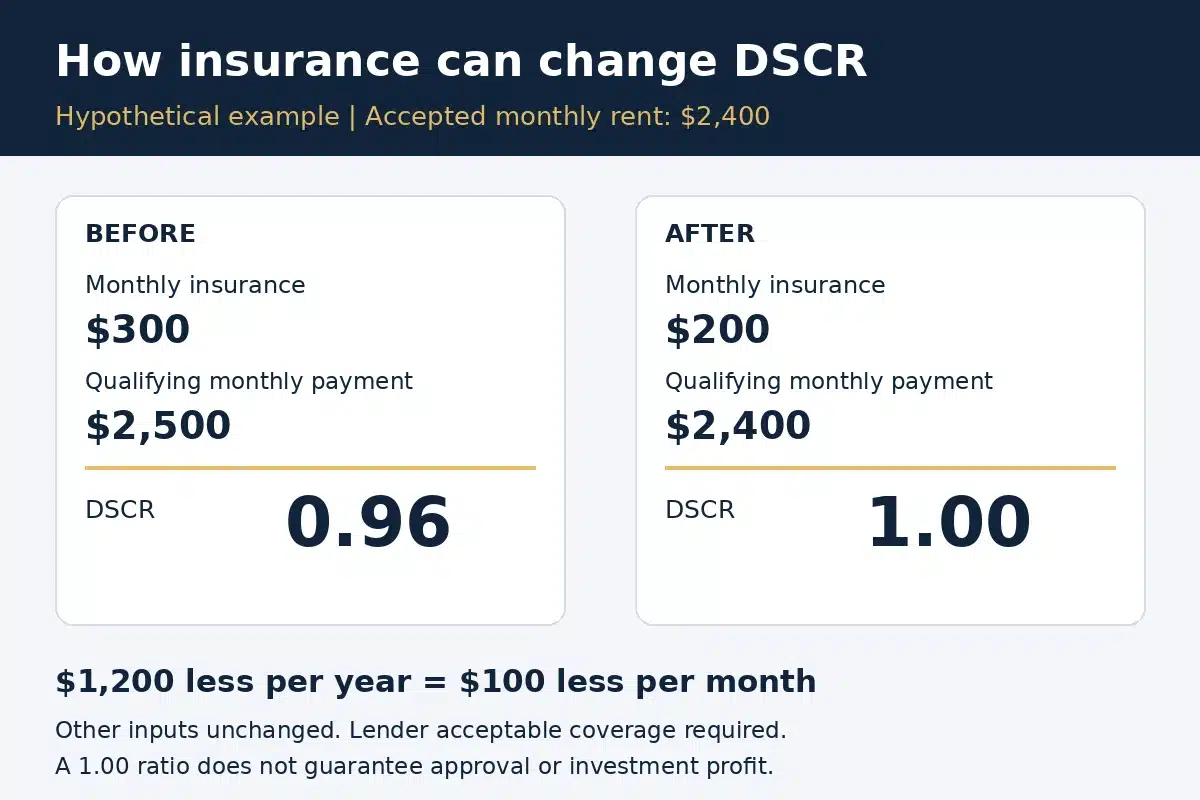
I look at insurance when a property’s ratio is close to the needed level. Saving about $100 per month means reducing the annual premium by $1,200. That amount can matter, but it is not a savings promise or a reason to choose inadequate coverage.
Compare quotes for the same property use and review coverage, exclusions, and deductibles with an insurance professional. The lender must accept the policy. A cheaper premium that leaves the property underinsured or does not meet financing requirements does not solve the problem.
What else can improve a low DSCR?
Possible options include reducing the loan amount, paying for a lower rate, comparing an available prepayment penalty structure, or correcting supported errors in the inputs. Each option needs a fresh quote and a review of its costs, restrictions, and effect on the investment.
In my work, buying down the rate or considering a longer prepayment penalty period can sometimes improve pricing enough to help the ratio. Visio’s pricing walkthrough illustrates how points, loan size, and penalty choices affect a quote. A rate buydown uses cash upfront, so compare that cost with the expected payment savings and your holding period.
A longer penalty period can be a poor fit if you expect to sell or refinance soon. Visio’s DSCR guide explains that early payoff can trigger charges under the loan agreement. Availability also depends on the lender, property, transaction, and applicable restrictions. Do not choose a penalty solely to reach a target ratio.
Does a 1.00 DSCR guarantee approval or positive cash flow?
No. A 1.00 ratio only means the rent used in that calculation equals the qualifying payment. Approval also depends on the program and the rest of the file. The ratio alone does not establish that the investment can cover repairs, vacancies, management, or other operating costs.
I often look for ways to bring a marginal ratio to 1.00 or higher, but that is not a universal minimum. Some programs require more coverage and others allow less under different terms. For example, Acra’s cited summary lists different minimums by lending channel. Confirm the requirement for your actual quote.
An investor should also prepare a separate operating budget. Even when a residential lender uses gross rent, you still pay for maintenance and turnover. Keep those costs in your investment analysis rather than assuming that a qualifying ratio is the same as profit.
Worked examples using hypothetical inputs
The following examples illustrate the arithmetic only. They are not rate quotes, offers, client results, or a complete investment budget. The payment figures are assumed inputs, not payments calculated from a particular loan amount or advertised interest rate.
Example one: the lease changes the result
Suppose an investor expects $3,000 in monthly market rent, but the occupied property has an existing lease at $2,400. With a qualifying payment of $2,500, the estimate based on $3,000 looks comfortable. A program that accepts only $2,400 produces a different result.
| Rent assumption | Monthly rent used | Qualifying monthly payment | DSCR |
|---|---|---|---|
| Investor’s market rent estimate | $3,000 | $2,500 | 1.20 |
| Current lease rent under the assumed program | $2,400 | $2,500 | 0.96 |
The arithmetic did not change. The accepted income did. Review the rent rule before assuming the property qualifies, and ask whether another suitable program evaluates the documentation differently. Do not rely on a future rent increase that the selected lender has not accepted.
Example two: insurance changes the payment
Now use the same $2,400 of accepted rent. Assume principal and interest of $1,600, monthly property taxes of $600, insurance of $300, and no association dues. The total qualifying payment is $2,500.
If an acceptable insurance quote reduces the annual premium from $3,600 to $2,400, monthly insurance falls from $300 to $200. The payment becomes $2,400, and the exact calculation changes from $2,400 ÷ $2,500 = 0.96 to $2,400 ÷ $2,400 = 1.00.
This illustrates why I recommend getting an insurance quote early. The savings are hypothetical, and reaching 1.00 does not guarantee approval. If the lender requires a higher ratio, this change alone is not enough.
Prepare your numbers before making an offer
Start with the current leases, proposed purchase price, planned down payment, property tax information, insurance quote, and any association dues. For a vacant property, identify the basis for your rent estimate and leave room for the appraiser’s conclusion to differ.
Keep two versions of your analysis: the lender’s qualification calculation and your own operating budget. Label assumptions clearly so an estimated tax bill or unconfirmed rent does not look like a verified figure. Recalculate when the appraisal, insurance, or loan terms change.
Our mortgage calculator can help you explore payment assumptions, but it does not determine the lender’s accepted rental income or establish DSCR approval. Bring the inputs to your loan officer for a property specific review.
Four steps to calculate your preliminary DSCR
- Confirm qualifying rent. Ask which lease or appraisal rent figure the selected program accepts.
- Build the monthly payment. Add the required principal, interest, taxes, insurance, and association dues using the lender's method.
- Divide rent by payment. Use the same time period for both figures and retain the unrounded result for the lender's review.
- Review the full investment. Compare the ratio with program requirements and prepare a separate budget for operating expenses and reserves.
Frequently asked questions
Can I use the seller’s projected rent to qualify?
Not automatically. The lender determines qualifying rent using its program rules and supporting documents. A projected rent in a listing may differ from the lease rent or appraisal rent the lender accepts.
Does paying insurance annually remove it from DSCR?
No. If the program includes insurance in the qualifying payment, paying the premium annually does not remove the expense. Convert the annual premium to a monthly amount for a monthly calculation.
Is a 1.00 DSCR enough for every lender?
No. Minimum coverage and other eligibility requirements vary by lender and program. A 1.00 ratio also does not guarantee positive cash flow after operating expenses.
Will the lender accept a higher rent after a reconsideration?
Not necessarily. Supporting rental comparables or factual corrections can be submitted through the lender’s process, but the review may leave the original rent conclusion unchanged.
Can I use this method for an Airbnb property?
Do not assume the same method applies. Short term rental programs may use different income records, occupancy assumptions, and expense adjustments. Ask the lender which method applies to that property and rental strategy.
Review Your Rental Property Financing Options
Buying or refinancing a rental property? MacLagan Home Loans can help you review accepted rents, estimated payments, and available DSCR financing options. Start with your property details so we can identify what needs to be verified.
No SSN required. Zero impact to credit. Your information is never sold.
Educational information, not a commitment to lend. Eligibility, documentation, pricing, prepayment terms, and approval depend on the lender, program, borrower, and property. All numerical examples are hypothetical. Sources checked October 9, 2026.

ABOUT THE AUTHOR
Alex MacLagan, Loan Officer
NMLS #1912744
Alex MacLagan is a mortgage loan officer with MacLagan Home Loans, licensed in Illinois, Wisconsin, Arizona, and Minnesota. Known to his clients as “Alex The Mortgage Doctor,” he works with first time buyers, move up buyers, self employed business owners, and real estate investors across Chicagoland and the north and northwest suburbs. Before lending, Alex spent years on the investing side of real estate with hands on experience across 100+ flips and rental properties, which shapes how he structures financing for clients today. When he’s not writing about mortgages or working with clients, you’ll find him with his fiancée and their dog.