

By Alex MacLagan, Loan Officer | NMLS #1912744
A DSCR loan prepayment penalty is a charge that can apply when you pay off a rental property mortgage or make certain extra principal payments before the penalty period ends. The amount depends on the structure in your loan documents. Selling the property and refinancing the mortgage can both trigger a charge.
The decision I encourage investors to make is simple: choose the penalty based on how long you expect to keep the loan. You might own a rental for ten years but refinance after two. Those are very different timelines when you compare financing options.
This guide covers common penalty structures for business purpose rental property loans, practical examples, and the questions to ask before closing. It is not a description of every lender’s program.
What are the common DSCR prepayment penalty types?
Common structures include a declining percentage, a fixed percentage, and a charge based on six months of interest. Some programs also offer a loan without a prepayment penalty. The structure and its duration are separate terms, so a three year penalty does not tell you how the fee is calculated.
For example, Visio Lending describes declining and fixed penalty options, while Plaza’s DSCR Investor Solutions 1 guidelines describe an interest based option and a fixed percentage. Availability differs by program.
How does a step down penalty work?
A step down penalty uses a percentage that decreases on the schedule stated in the loan agreement. With a 5/4/3/2/1 schedule, the percentages are 5%, 4%, 3%, 2%, and 1% over the five designated years. A 3/2/1 schedule uses 3%, 2%, and 1% over three years.
Confirm what principal amount the percentage applies to and the exact dates when each step changes. Do not assume the penalty decreases on January 1. Request the schedule in writing so you can compare a planned payoff date with the applicable percentage.
How does a fixed percentage penalty work?
A fixed percentage penalty keeps the same percentage throughout its stated period. For example, a flat 3% charge remains 3% during that period instead of declining each year. The dollar amount can still change if the principal amount subject to the charge changes.
Ask whether the percentage applies to the outstanding balance at full payoff, an extra principal payment, or another amount defined in the rider. Two quotes described as having a three year penalty can produce very different payoff costs.
How does the six months of interest penalty work?
Under one published structure, the penalty equals six months of interest on principal prepaid above an allowance of 20% of the original loan balance in a rolling 12 month period. Lendz Financial explains this method. It is not automatically six full mortgage payments or six months of interest on the entire balance.
For an illustration of the principal calculation, assume an original loan of $300,000, an unused 20% allowance, and a $100,000 extra principal payment. The allowance is $60,000, leaving $40,000 subject to the interest calculation under these assumptions. The fee then depends on the rate and calculation method specified in the rider.
Before applying that example to your mortgage, confirm how previous payments affect the remaining allowance. Also confirm the measurement period. A rolling 12 month window is not necessarily a calendar year, and the original principal balance is different from today’s outstanding balance.
Can you get a DSCR loan with no prepayment penalty?
Some DSCR programs offer a no penalty option. It can provide more flexibility to sell or refinance, but the quote may carry a higher interest rate or different upfront costs. Request actual comparisons rather than assuming a standard rate premium applies to every loan.
In my loan comparisons, I look at the cost of that flexibility alongside the investor’s plans. An investor expecting an early refinance has a different reason to consider it than someone comfortable keeping the same financing for several years. Our DSCR loan options are a starting point for that conversation.
A payoff example: the same balance, different penalties
The following illustration assumes a full payoff during year two and a $300,000 outstanding principal balance. Each percentage is assumed to apply to that full balance. These are hypothetical calculations, not loan quotes or actual borrower results.
| Assumed structure | Percentage at the illustrated payoff | Penalty calculation | Illustrative fee |
|---|---|---|---|
| Five year 5/4/3/2/1 | 4% | $300,000 × 4% | $12,000 |
| Three year 3/2/1 | 2% | $300,000 × 2% | $6,000 |
| Flat 3% during a three year period | 3% | $300,000 × 3% | $9,000 |
| No prepayment penalty | None | No penalty charge | $0 |
The no penalty row does not mean the loan or refinance has no other costs. It only means there is no prepayment penalty under that assumed option. The other rows exclude regular payoff interest, closing costs, and any other applicable charges.
This comparison is why I ask investors to look beyond the phrase “three year prepay.” The percentage, calculation basis, and expiration date all matter. Ask for a dollar estimate at the month you actually expect to sell or refinance.
Does selling trigger the same penalty as refinancing?
In the programs I am describing here, both selling and refinancing can trigger the penalty because either transaction pays off the existing mortgage. This is commonly called a hard prepayment penalty. Do not assume a sale creates an exemption unless your documents expressly provide one.
Plaza’s published program guidelines, for example, state that the penalty applies to payoff through either sale or refinance. That is a program example, not a rule for every mortgage. Have your loan officer identify the trigger language in the proposed rider before you choose the loan.
The same review should address extra principal payments. A borrower may keep the property and the mortgage but still trigger a fee with a large principal reduction. Before sending a substantial payment, ask the servicer for a written explanation of any allowance and the resulting charge.
Should you choose a one, three, or five year penalty?
Choose by comparing your likely loan holding period with the available pricing and potential exit cost. In my recommendations, a shorter penalty period deserves a close look when the investor may sell or refinance relatively soon. A longer period requires confidence that the pricing benefit fits the plan.
If an investor thinks rates may decline and hopes to refinance, I may recommend comparing a one or three year penalty with a five year option. That is planning for a possibility, not predicting rates. The loan should still be affordable if refinancing never becomes attractive or available.
Ask yourself when you would consider selling, taking equity out, or changing the financing. Write down an earlier exit as well as your expected timeline. Then compare the cost under both scenarios. A plan that only works if rates fall quickly leaves an important part of the investment unresolved.
Also separate qualification from your exit strategy. A pricing change may affect the payment used in your rental property DSCR calculation, but qualifying today does not establish that an early payoff charge is a good tradeoff for you.
Is a lower rate worth accepting a longer penalty?
It can be, but the answer requires actual quotes and an expected payoff date. Compare upfront costs, payments, projected balances, and the penalty at that date. A smaller monthly payment alone does not show which loan leaves you in the better financial position.
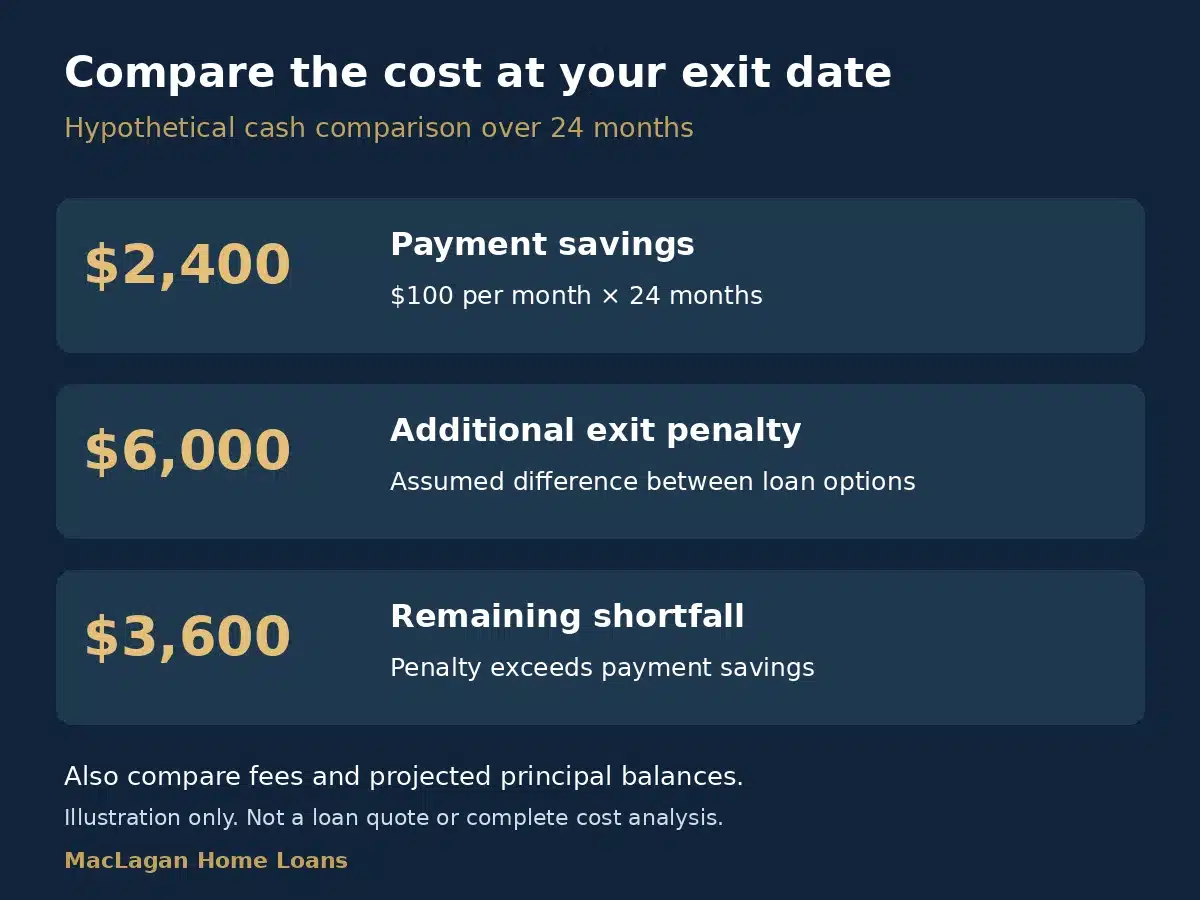
As a simple hypothetical cash comparison, suppose one option reduces monthly outflow by $100 for 24 months. That produces $2,400 of payment savings. If it also creates a $6,000 additional penalty at the planned exit, the payment savings alone fall $3,600 short of that charge.
This is a limited illustration, not a complete loan cost analysis. Different interest rates and amortization schedules can leave different principal balances. Points, lender credits, other fees, and the timing of cash flows can also change the comparison. Use the actual quotes to calculate the full difference.
Visio’s pricing walkthrough shows that penalty selections and points are inputs in its quote process. When reviewing alternatives, keep the property, loan amount, and other assumptions consistent so you can see what the penalty choice changes.
Five steps to compare DSCR prepayment options
Use this checklist before choosing your loan. Keep the written quotes and proposed rider together so the pricing and penalty terms can be reviewed as one decision.
- Set your loan timeline. Identify when you expect to sell or refinance, then add an earlier exit scenario and a scenario where you keep the loan longer.
- Request comparable quotes. Ask for available shorter, longer, and no penalty options using the same property and loan assumptions. Compare points and lender credits as well as the rate.
- Read the penalty rider. Confirm the structure, calculation basis, start and end dates, treatment of a sale or refinance, and any allowance for extra principal payments.
- Calculate costs at your planned exit. Compare upfront costs, payments, projected principal balances, and the applicable penalty. For an existing loan, obtain a dated payoff statement from the servicer.
- Check the plan before committing. Review the results with your loan officer, confirm the selected program permits the terms for your transaction, and make sure the loan still fits if your timeline changes.
For a purchase, I would rather discuss a possible refinance now than have the penalty become a surprise later. For an existing loan, bring the note and any prepayment rider to the conversation. A shorthand description in an old quote may not tell us enough about the signed agreement.
Frequently asked questions
Does the penalty disappear when the loan is sold to another servicer?
A servicing transfer alone should not be treated as a cancellation of your penalty. Use your signed loan documents and request written payoff information from the current servicer before assuming the terms have changed.
Can I add the penalty to my refinance loan?
Possibly, if the new program and available equity permit a loan amount that covers it. Financing the charge does not eliminate its cost. Ask for a comparison showing the new balance, closing costs, and any cash you must bring.
Is waiting until the next penalty step always better?
No. A smaller penalty may help, but waiting can introduce other costs or risks. Compare the penalty reduction with the cost of keeping the current loan and the uncertainty of future financing or sale terms.
Are the same penalties available in every state?
No. Program restrictions and applicable law can affect availability, and some programs distinguish between an individual borrower and an entity. Confirm the options for your property and borrowing arrangement rather than applying another investor’s terms to your loan.
What should I request before paying off my DSCR loan?
Request a written payoff statement for your intended payoff date, including any prepayment charge, and compare it with your note and rider. If a penalty is about to decrease or expire, ask the servicer to confirm the exact date and calculation.
Compare DSCR Financing for Your Investment Plan
Buying or refinancing a rental property? MacLagan Home Loans can help you compare available DSCR financing and prepayment terms around your expected loan timeline. Bring your property details, current loan documents if applicable, and plans for a future sale or refinance.
No SSN required. Zero impact to credit. Your information is never sold.
Educational information,not a commitment to lend. Examples are hypothetical. Eligibility, pricing, prepayment terms, and approval depend on the lender, program, transaction, and applicable requirements. Your signed loan documents govern the actual penalty. Sources checked October 12, 2026.

ABOUT THE AUTHOR
Alex MacLagan, Loan Officer
NMLS #1912744
Alex MacLagan is a mortgage loan officer with MacLagan Home Loans, licensed in Illinois, Wisconsin, Arizona, and Minnesota. Known to his clients as “Alex The Mortgage Doctor,” he works with first time buyers, move up buyers, self employed business owners, and real estate investors across Chicagoland and the north and northwest suburbs. Before lending, Alex spent years on the investing side of real estate with hands on experience across 100+ flips and rental properties, which shapes how he structures financing for clients today. When he’s not writing about mortgages or working with clients, you’ll find him with his fiancée and their dog.