
By Alex MacLagan, Loan Officer | NMLS #1912744
Yes, you may be able to buy a house before selling your current home. The right approach depends on whether you qualify for the new mortgage and have an acceptable source of money for the down payment and closing costs. Equity in your current home can help, but it is not the same as cash available for your next closing.
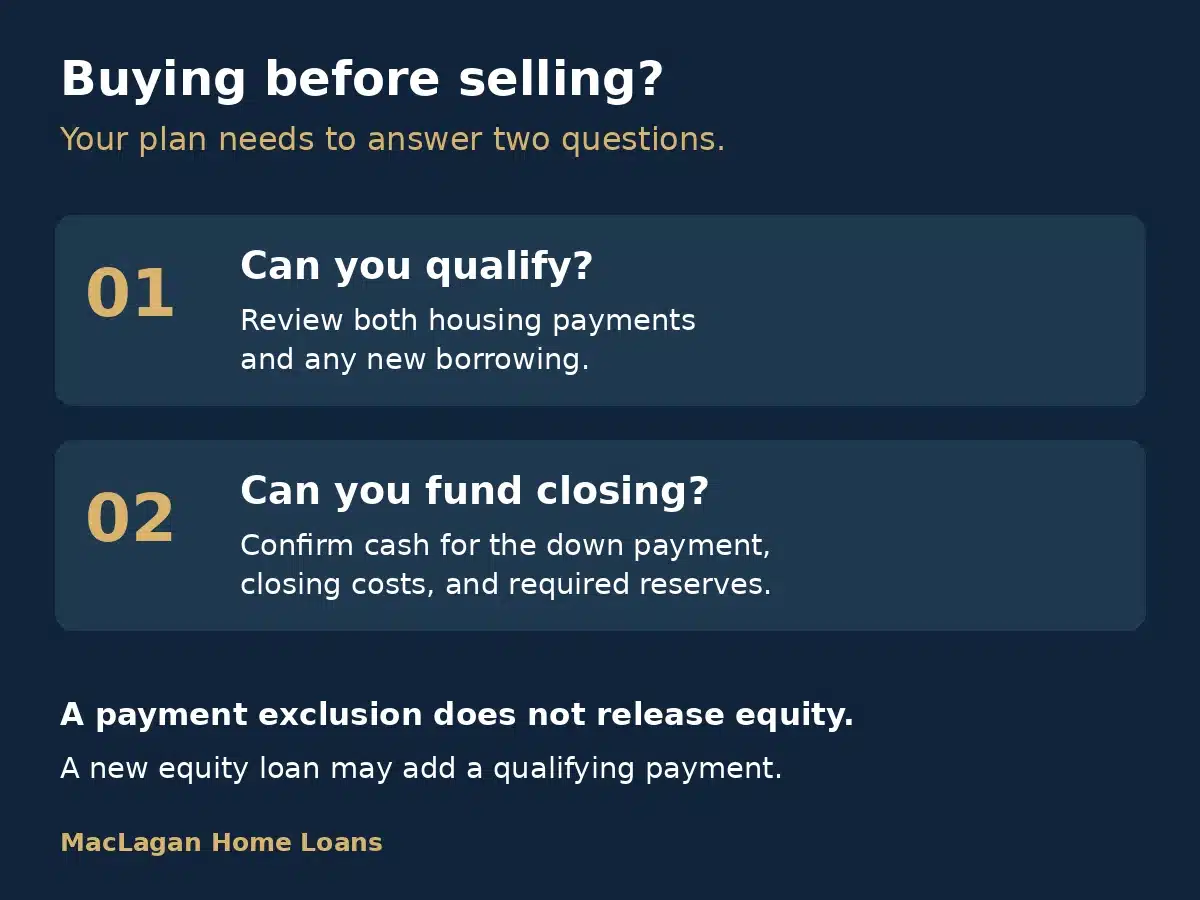
At MacLagan Home Loans, I start with those two questions. The obstacles I see most often are a debt to income ratio that is too high when both homes are counted, and the need to access equity before the current home sells. A useful plan must address whichever problem applies to you, or both.
Do you have to qualify with both mortgage payments?
Often, yes, unless the selected program permits an exclusion and the lender has the required documentation. A plan to sell your current home does not automatically remove its payment from mortgage qualification.
For a purchase using Fannie Mae guidelines, a current principal residence that is pending sale generally requires both housing payments to be counted if the sale will not close before the new purchase. However, Fannie Mae permits an exception with an executed sales contract and confirmation that any financing contingencies have cleared.
Being listed for sale is not the same as having that documentation. An accepted offer alone may not establish that the buyer’s financing contingency has cleared. Your loan officer must confirm the rule for your actual program and have the lender review the evidence.
Even when the existing payment can be excluded for qualification, the payment obligation does not disappear. You still need a plan for the costs you remain responsible for until the sale closes. Approval and a comfortable household budget are separate considerations.
What if you need the equity for your down payment?
You need an approved way to make those funds available before your purchase closes. Excluding an old housing payment from the debt to income calculation does not release equity from the property or pay your new closing costs.
I ask borrowers to separate the amount they expect to receive when they sell from the amount they need to close today. Those numbers can be very different. Your expected sale proceeds should allow for existing loan payoffs, selling expenses, and any other required deductions.
Before opening another loan, have your purchase lender review it. A solution that provides cash can also create a payment that affects qualification. Timing matters too: an approved credit line is only useful for closing if the funds can be accessed and documented when needed.
Which options can help you buy before selling?
The options I review include bridge loans, HELOCs, home equity loans, a smaller initial down payment with a later eligible recast, and certain sale contingency programs. They solve different problems. The best starting point is to identify whether you need cash, help qualifying with both homes, or both.
| Option to review | What it may help address | Main issue to verify |
|---|---|---|
| Bridge loan | Funds needed before the current home sells | Payment treatment, costs, repayment deadline, and sale delays |
| HELOC | Access to an approved credit line secured by current home equity | Availability, usable funds, payment, and listing restrictions |
| Home equity loan | A lump sum secured by current home equity | Added payment, costs, and repayment at sale |
| Smaller down payment and later recast | Buying with less cash initially, then reducing the payment later | Qualification at closing and written recast eligibility |
| Sale contingency program | An eligible structure to help coordinate buying and selling | Written terms, fees, lender acceptance, and actual cash available |
How can a bridge loan help?
A bridge loan can provide funds for a new purchase before the current residence sells. It does not automatically solve a debt to income problem. Review its payment treatment and repayment terms with the lender handling the new mortgage.
Fannie Mae’s debt guidelines generally include the bridge loan obligation, with an exception requiring a fully executed sale contract and cleared financing contingencies. Other programs may differ.
When comparing a bridge loan, I would look beyond the amount available. Ask for the fees, interest costs, payoff requirements, and what happens if your home does not sell on the expected schedule. Make sure the purchase plan does not depend on a deadline you cannot control.
Could a HELOC or home equity loan provide the funds?
An eligible HELOC or home equity loan may let you borrow against your current home before selling. The Consumer Financial Protection Bureau distinguishes a credit line from a lump sum loan: a HELOC permits draws within its terms, while a home equity loan provides the borrowed amount at once. Both add an obligation when your existing mortgage remains in place.
Ask about the actual funds available after fees, how the purchase lender counts the payment, and whether the equity lender allows a listed property or a planned near term sale. Do not assume every program is designed for this use.
Our home equity financing page introduces this option. For buying before selling, the review needs to focus on your full transaction, including when you can access the funds and how the equity loan will be paid off.
Can you buy with less down and recast after selling?
Yes, when you qualify for the initial purchase and the new loan is eligible for a recast. A recast recalculates the required principal and interest payment after a principal reduction using the remaining loan term and existing interest rate. It is different from refinancing into a new loan.
Chase’s recast explanation illustrates the process and notes that eligibility depends on investor guidelines. Do not assume every conventional loan or servicer offers identical terms. Ask about eligibility, minimum principal reduction, fees, timing, and how to request it before closing.
This is an option I review when the borrower can qualify with both mortgages and has enough money for the initial down payment and costs. After the sale, the borrower can use part of the net proceeds to reduce the new balance and request the agreed recast process.
A future recast does not let you qualify using a hoped for lower payment today. You must qualify for the loan you actually close. Also ask separately about mortgage insurance and escrow costs instead of assuming a principal payment automatically resolves them.
How do programs such as Zoom Casa fit into the plan?
We also work with companies such as Zoom Casa to review eligible arrangements designed to help borrowers buy without a home sale contingency. These are separate from the approval of your new mortgage, and the purchase lender must accept the actual structure and documentation.
Zoom Casa’s Buy Before You Sell page advertised a $999 flat program fee when checked on October 12, 2026. That is the provider’s published program fee, not a quote for your transaction or a statement that your mortgage and home sale have no other costs.
Request the written agreement and a clear explanation of what happens to your existing property, which obligations you retain, and what funds are available at each stage. Confirm the purchase lender’s treatment before relying on a payment exclusion. Program approval by another company does not itself establish mortgage approval.
An example: cash available and qualification are separate
Suppose a household has $35,000 available for the purchase, while the proposed down payment and closing costs total $60,000. The immediate funding gap is $25,000. A future sale might produce enough proceeds to cover it, but those proceeds are not yet available for closing.
Now suppose the same household also cannot qualify when both housing payments are included. An equity loan that fills the $25,000 gap may leave the qualification issue unresolved. Its payment may also affect the calculation. Conversely, an acceptable pending sale exclusion might address qualification while leaving the cash gap untouched.
These figures are hypothetical, not a borrower case or loan quote. They illustrate why I review the funding plan and qualifying payments together. Before making an offer, ask your loan officer to show which part of the plan solves each problem and which items still need approval.
Build a budget for the time between closings
Estimate the costs you may carry while you own both properties, including housing payments, utilities, insurance, moving, and any financing or program charges. Leave room for repairs or a later sale date rather than using only the most optimistic timeline.
Have your real estate agent prepare an estimated seller net sheet. Review a realistic sale price and selling expenses, then compare the projected net proceeds with planned loan payoffs and any later principal payment. The amount you can put toward a recast should come from that net estimate, not the home’s headline value.
I prefer to explore the available ways to buy first before recommending that a borrower sell first. In my approach, selling first becomes the recommendation when the borrower cannot qualify for a workable buy before selling option. Your comfort with the costs and timing should also guide the choice.
Five steps to plan your purchase before selling
Start this review before making an offer. Our guide to the mortgage preapproval process explains the broader preparation. For a move involving two properties, add the following steps.
- Document both homes. Gather current mortgage and equity loan statements, taxes, insurance, association dues, and an estimated price range for the next home.
- Separate the two obstacles. Have your loan officer calculate qualification with the required payments and identify the cash needed for down payment, closing costs, and any required reserves.
- Compare eligible options. Review the available bridge loan, equity financing, smaller down payment, recast, and sale contingency structures against your actual needs.
- Confirm the terms in writing. Verify lender acceptance, funding dates, fees, payment treatment, payoff requirements, and recast eligibility where applicable.
- Plan for a slower sale. Review the carrying costs and backup plan with your loan officer and real estate agent before committing to the purchase timeline.
Frequently asked questions
Is having my current home under contract enough to remove its payment?
Not by itself. Under the Fannie Mae pending sale exception discussed here, the lender needs an executed sales contract and confirmation that any financing contingencies have cleared. Your actual loan program and lender determine the documentation required.
Can I use expected sale proceeds before my home closes?
Expected proceeds are not cash already available for your new closing. If the purchase closes first, you need another acceptable funding source or an approved structure that makes funds available in time.
Does making a large principal payment automatically lower my mortgage payment?
Do not assume it does. A principal reduction lowers the balance, but lowering the required principal and interest payment through a recast requires an eligible loan and the servicer’s process. Confirm the terms before relying on that result.
Can I remove a home sale contingency before my financing is confirmed?
I recommend confirming the financing and funding plan first. Removing a contractual protection can create obligations even if your expected loan or sale does not work out. Review the offer terms with your agent and attorney where applicable.
What if I decide to keep my current home as a rental instead?
Tell your loan officer before changing the plan. Keeping the home as a rental requires a different review of the existing payment, any proposed rental income, and the applicable loan requirements. Approval based on a planned sale does not automatically carry over.
Plan Your Next Home Purchase
Want to buy your next home before selling your current one? MacLagan Home Loans can help you review qualification, available equity, and financing options around both closings. Start with your current mortgage balance, estimated home value, available savings, and target purchase price.
No SSN required. Zero impact to credit. Your information is never sold.
Educational information, not a commitment to lend. Eligibility, fees, availability, documentation, and approval depend on the lender, program, borrower, property, and transaction. Third party terms can change. Sources checked October 12, 2026.

ABOUT THE AUTHOR
Alex MacLagan, Loan Officer
NMLS #1912744
Alex MacLagan is a mortgage loan officer with MacLagan Home Loans, licensed in Illinois, Wisconsin, Arizona, and Minnesota. Known to his clients as “Alex The Mortgage Doctor,” he works with first time buyers, move up buyers, self employed business owners, and real estate investors across Chicagoland and the north and northwest suburbs. Before lending, Alex spent years on the investing side of real estate with hands on experience across 100+ flips and rental properties, which shapes how he structures financing for clients today. When he’s not writing about mortgages or working with clients, you’ll find him with his fiancée and their dog.