
By Alex MacLagan | NMLS #1912744
For a DSCR purchase, plan for the down payment, closing costs, prepaid expenses, and any reserves the lender requires you to retain after closing. Those amounts are different from the final amount you send to the closing agent. Your earnest money deposit and eligible credits can reduce that final amount, while reserves remain separate from the money spent on the purchase.
At MacLagan Home Loans, I also look at what the investor needs after the deal closes. A loan can meet a lender’s requirements and still leave the owner with too little cash for repairs, vacancy, or the next investment. The goal is to compare a complete budget before committing to the property.
Is the down payment the same as cash to close?
No. The down payment is your contribution toward the purchase price. Cash to close also accounts for transaction charges, prepaid items, deposits already paid, and applicable credits or adjustments. Required reserves are generally assets you must document remaining after closing rather than another fee paid to the lender.
For example, a 20% down payment on a $300,000 purchase is $60,000. That calculation alone does not include appraisal charges, lender fees, title costs, insurance, or reserve requirements. The actual down payment available for your transaction depends on the lender, property, credit profile, rental qualification, and other program conditions.
Ask for two figures: the estimated amount needed to complete the purchase and the eligible assets that must remain afterward. Then compare those figures with your operating budget. A retirement balance that counts toward underwriting reserves may not be money you want to use for an unexpected repair.
What closing costs should you budget for on a DSCR loan?
Request an itemized estimate that separates lender and broker charges, property and settlement services, and prepaid expenses. DSCR costs vary by lender and transaction, so a single percentage of the purchase price is only a planning shortcut, not a reliable final quote.
Potential charges include origination or processing fees, discount points, appraisal and rental analysis, title insurance, settlement or attorney services, recording charges, and applicable transfer taxes. Confirm who pays each charge under the purchase contract and local requirements. Some expenses may be paid before the closing date.
The CFPB’s overview of mortgage closing charges explains common cost categories. It is useful background on terminology, not a statement that every consumer mortgage disclosure rule applies to a business purpose DSCR transaction.
Also separate discount points from other origination charges. Freddie Mac explains that one discount point equals 1% of the loan amount, although the rate reduction varies. On an illustrative $240,000 loan, one point costs $2,400. Paying points and increasing the down payment are different decisions, even when both may improve the financing terms.
What are prepaid expenses and escrow deposits?
Prepaid expenses cover items paid in advance, such as insurance or interest, while an initial escrow deposit funds an account used for eligible future property bills. These amounts can increase the money needed for the transaction even though they are different from lender fees.
Get an insurance estimate early and confirm how taxes, insurance, and any association charges will be handled. The closing date, tax schedule, seller prorations, and escrow requirements can change the final figures. Do not assume another investor’s closing statement will match yours.
When comparing quotes, check whether both include the same prepaid and escrow assumptions. One estimate may appear cheaper simply because it omits an item that will still be due. If a cost was already paid, make sure it is accounted for once rather than added to the remaining funds again.
How many months of reserves do DSCR lenders require?
In my experience, three or six months is common, but the requirement depends on the lender and loan. Confirm both the required number of months and the payment components used to calculate that amount. Do not assume every program uses the same reserve calculation.
For a hypothetical qualifying monthly housing expense of $2,300, three months equals $6,900 and six months equals $13,800. If the program includes principal, interest, property taxes, insurance, and association dues, using principal and interest alone would understate the requirement.
Reserves are not another down payment and generally are not wired to the lender as a reserve fee. They demonstrate that eligible assets remain after the transaction. Other financed properties, loan features, or borrower circumstances may change the required amount under the selected program.
Ask us to confirm the reserve requirement before deciding how much to put down. Increasing the down payment can reduce the mortgage payment, but it also uses assets that might otherwise satisfy reserves or support the property after closing.
A sample budget for a $300,000 rental purchase
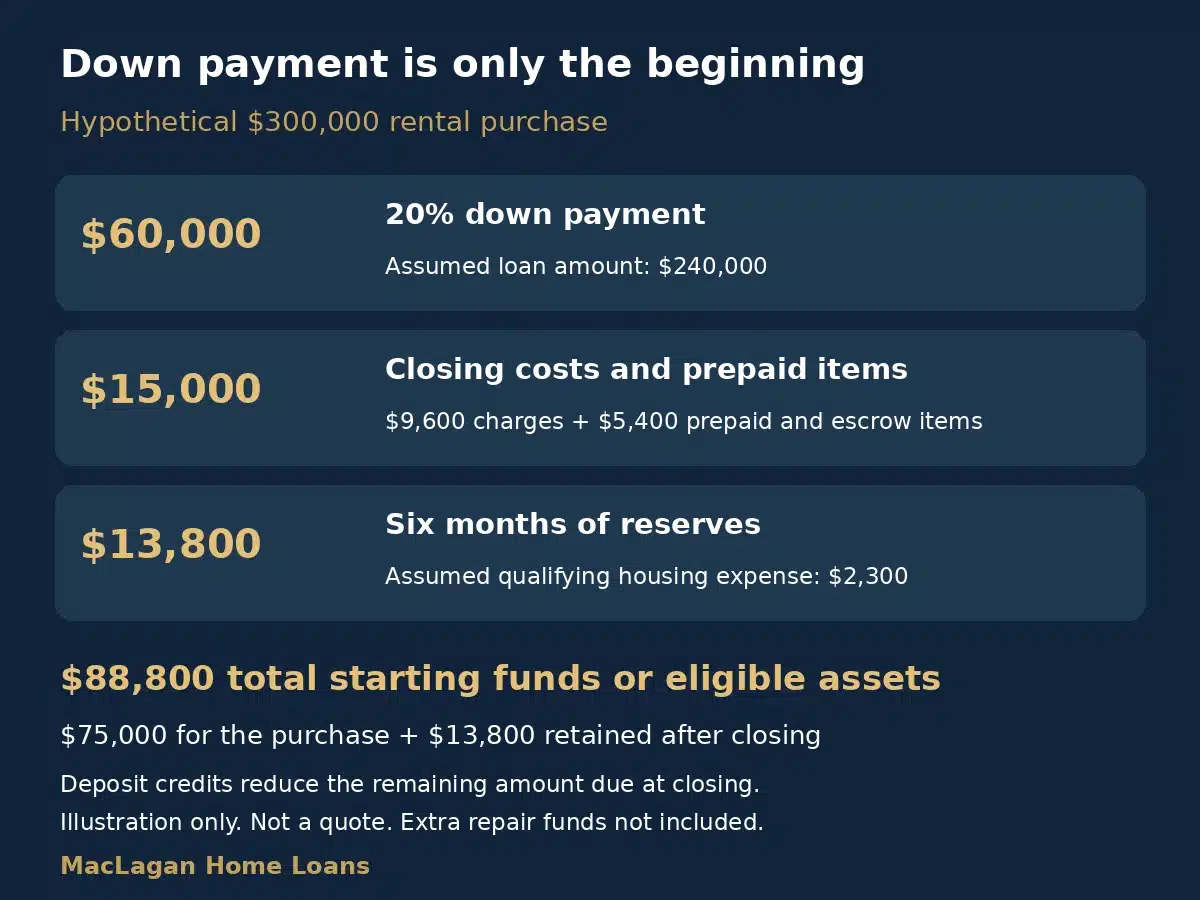
The following example is hypothetical and is not a rate quote, approval, or estimate of your closing costs. It assumes a $300,000 purchase, 20% down, a $240,000 loan, no seller or lender credits, and six months of reserves based on an assumed $2,300 monthly qualifying housing expense. The payment assumption is used only for reserve arithmetic, not as an advertised loan payment.
| Budget item | Illustrative amount | How to treat it |
|---|---|---|
| Down payment | $60,000 | Money applied toward the purchase |
| Closing charges, including any selected points | $9,600 | Assumed transaction costs |
| Prepaid expenses and initial escrow deposits | $5,400 | Assumed amounts funded for the transaction |
| Total purchase funds before deposit credit | $75,000 | Down payment plus the two cost categories |
| Earnest money already paid | $6,000 | Part of the $75,000, not an additional cost |
| Remaining estimated funds to close | $69,000 | $75,000 less the $6,000 deposit |
| Six months of required reserves | $13,800 | Eligible assets retained after closing |
| Total starting funds or eligible assets | $88,800 | $75,000 for the transaction plus $13,800 retained |
If the earnest money has already left your account, this example calls for $82,800 remaining: $69,000 to finish closing plus $13,800 retained. The original $6,000 deposit is already accounted for. No other costs paid in advance or closing adjustments are assumed.
With a three month reserve requirement instead, the illustrative total starting requirement would be $81,900. An additional $5,000 repair budget on top of the six month reserve cushion would raise the planning target to $93,800. That extra repair allocation is an investor choice in this example, not a universal lender requirement.
Which assets can count toward DSCR reserves?
Bank balances are one potential source, and some programs accept eligible investment, retirement, or business assets under specific conditions. The amount counted may be less than the statement balance. Ask which assets qualify, what documentation is needed, and whether funds used for closing must first be liquidated.
For a lender specific example, EPM’s published DSCR Prime guidelines describe adjustments to certain investment and retirement balances, conditions for business funds, and restrictions on reserve sources. Those provisions illustrate why an account balance should not automatically be treated as fully usable. Confirm the current matrix for the program being considered.
Provide complete statements and explain large deposits or transfers before moving funds. If the money belongs to an LLC with other owners, access and ownership may require additional review. Our guide to DSCR loans in an LLC explains why entity documentation should be addressed early.
When should you make a larger down payment?
I consider a larger down payment when it can improve the DSCR, help the property meet the investor’s cash flow target, or produce more favorable pricing through a lower loan to value ratio. The benefit must be weighed against the cash left after closing and the actual offers available.
One important goal can be moving the DSCR to 1.00 or higher. In the programs I work with, crossing that threshold can materially affect pricing or available options. It is not a universal approval line or a promise of a particular rate improvement.
As a simple illustration, $2,200 in accepted monthly rent divided by a $2,300 qualifying housing expense produces a DSCR of approximately 0.96. If an available financing option reduces that expense to $2,200, the ratio becomes 1.00. The example does not establish how much extra down payment would be needed; that requires the actual loan terms.
Our DSCR calculation guide explains the ratio. Remember that qualifying DSCR is not the same as net cash flow after maintenance, management, vacancies, and other operating expenses. Review both before committing extra cash.
Keep your operating cushion and exit costs in view
The lowest possible mortgage payment is not automatically the best use of your cash. Compare the additional down payment with the payment reduction, pricing change, and funds remaining for the property. Consider how a vacancy or immediate repair would affect your ability to carry the investment.
A separate cost investors can overlook is the prepayment penalty. On a purchase, that is generally a potential future expense if the loan is paid down or paid off in a way that triggers the penalty. It should not be added to the purchase closing budget as though it were automatically due that day. On a refinance, a penalty owed on the existing loan can affect the payoff and proceeds.
Structures can include a flat percentage, a declining percentage schedule, or an interest based formula. For example, a five year declining schedule may use 5%, 4%, 3%, 2%, and 1% in successive years. The loan documents determine the calculation base, triggering events, and any exceptions. Review our DSCR prepayment penalty guide alongside the actual loan terms.
Five steps to build your DSCR purchase budget
- Confirm the financing assumptions. Review the purchase price, available loan amount, down payment, and rental qualification for the actual property.
- Separate the transaction costs. Request lender charges, settlement costs, prepaid expenses, and escrow deposits without counting the same item twice.
- Account for funds already paid. Identify earnest money and other documented payments, then apply eligible credits and adjustments to estimate the remaining cash to close.
- Verify the reserve requirement. Confirm the required months, qualifying housing expense, accepted assets, and amount that must remain after closing.
- Compare the investment plan. Review alternative down payments, operating cash, points, and any future payoff penalty before choosing the loan.
Frequently asked questions
Can I use all my savings for the DSCR down payment?
Only if the rest of the transaction and any required reserves are covered by other eligible funds. A down payment alone does not establish that you have enough assets to qualify or enough accessible cash to operate the property.
Are DSCR reserves paid to the lender at closing?
Generally, no. Reserves are eligible assets you document remaining after closing. They are separate from initial escrow deposits and other amounts collected for the transaction.
Does my earnest money deposit count toward the money needed to close?
A documented deposit that is properly credited reduces the remaining amount due at closing. It is part of the total purchase funds, not an extra down payment on top of that total.
Can a retirement account count toward DSCR reserves?
Some programs accept eligible retirement assets, subject to documentation, access rules, and possible reductions to the balance counted. Confirm the lender’s requirements rather than assuming the entire account qualifies or must be withdrawn.
Will putting more money down always give me a better DSCR rate?
No. A lower loan amount may improve DSCR and LTV, but pricing depends on the lender’s tiers and the complete file. Compare actual offers and the cash remaining after closing before deciding.
Plan Your Next Rental Property Purchase
Have a property in mind and want to know how much money you will need? MacLagan Home Loans can compare your DSCR down payment options, estimated closing costs, and reserve requirements. Bring the property details, expected rents, and your available funds so we can review a budget that fits your investment plan.
No SSN required. Zero impact to credit. Your information is never sold.
Explore our DSCR loan options for additional program information.
Educational information, not a loan commitment, rate quote, or guarantee of approval. Examples use hypothetical assumptions and do not represent available loan terms. Requirements and costs vary by lender, property, borrower, and location and may change. Actual loan and closing documents govern the transaction.

ABOUT THE AUTHOR
Alex MacLagan, Loan Officer
NMLS #1912744
Alex MacLagan is a mortgage loan officer with MacLagan Home Loans, licensed in Illinois, Wisconsin, Arizona, and Minnesota. Known to his clients as “Alex The Mortgage Doctor,” he works with first time buyers, move up buyers, self employed business owners, and real estate investors across Chicagoland and the north and northwest suburbs. Before lending, Alex spent years on the investing side of real estate with hands on experience across 100+ flips and rental properties, which shapes how he structures financing for clients today. When he’s not writing about mortgages or working with clients, you’ll find him with his fiancée and their dog.