By Alex MacLagan | NMLS #1912744
Yes. Eligible DSCR loan programs allow an LLC to purchase or refinance a rental property, subject to the lender’s entity and borrower requirements. The lender still needs to verify the company, its owners, who can sign, and who must personally guarantee the debt. Closing in an LLC does not automatically remove personal responsibility for the loan.
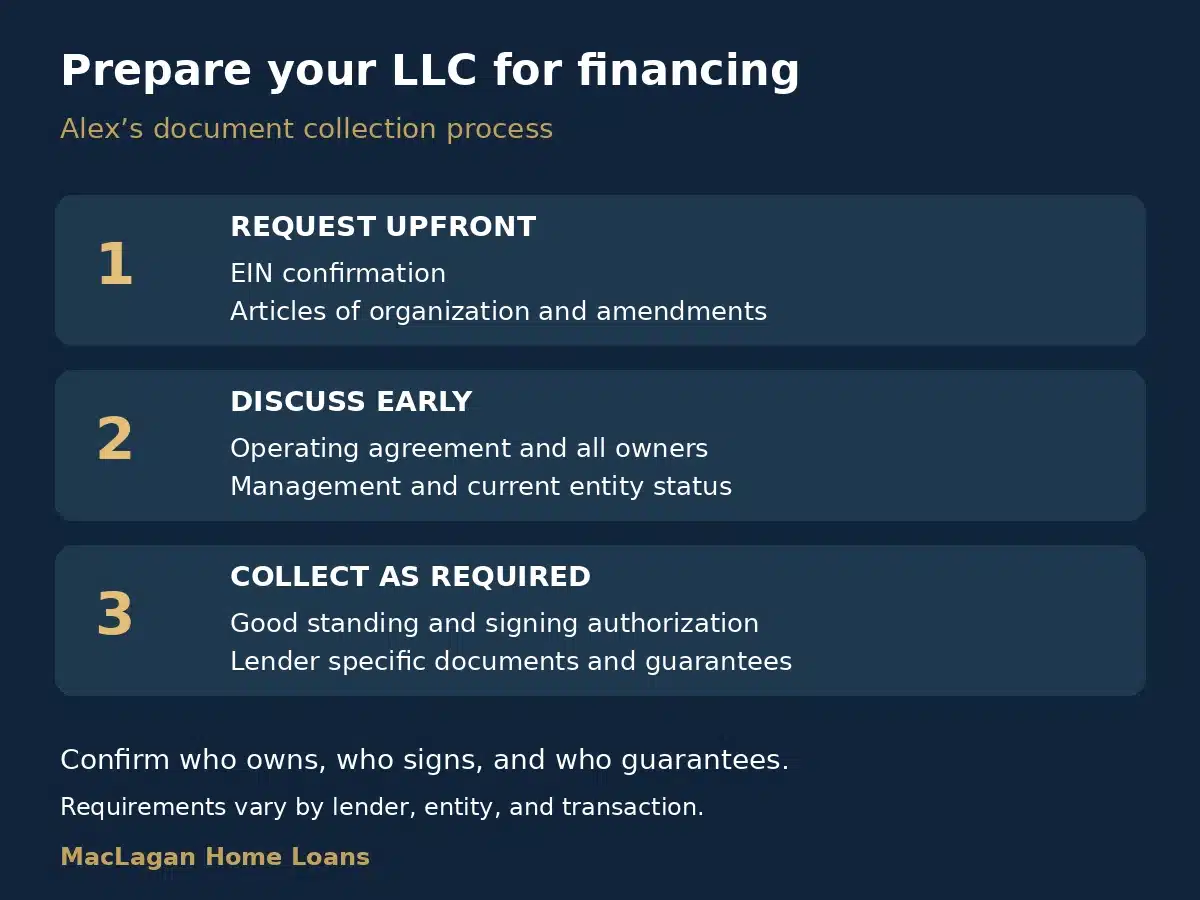
At MacLagan Home Loans, I start the entity review with two documents: the EIN confirmation and articles of organization. I ask about the remaining documents early and collect them as we move into the mortgage process. Finding a missing document or ownership issue before closing week gives us more time to resolve it.
What does it mean to get a DSCR loan in an LLC?
It means an eligible limited liability company is part of the approved borrowing and title structure for the rental property. DSCR financing evaluates the property’s rental income under the lender’s rules, but the LLC and any required individual applicants or guarantors must also satisfy program requirements.
DSCR stands for debt service coverage ratio. It measures qualifying rental income against the housing expense used by the program. Entity approval and rental qualification are separate parts of the review. A properly organized LLC does not make a property with insufficient qualifying rent automatically eligible.
Before choosing a lender, explain whether the property is already owned by the LLC, will be purchased by it, or is currently titled in your personal name. Those are different situations. Do not assume that a later title transfer is permitted without reviewing the existing loan documents and obtaining any required approvals.
Our DSCR loan options provide an overview of rental property financing. This guide focuses on the entity documents and decisions that help prepare an LLC transaction for closing.
Which LLC documents do I request upfront?
I request the EIN confirmation and articles of organization at the beginning of the review. I also ask whether the operating agreement, current ownership information, and evidence of good standing are available. Those additional items become part of the documentation process once we get started on the mortgage.
The articles of organization establish the company’s formation information. The EIN confirmation helps verify the company’s federal tax identification number. They serve different purposes, so having one does not replace the other. Include any amendments that affect the entity’s name or structure.
The IRS explains how to confirm an EIN, including requesting a verification letter if the original notice is unavailable. Before ordering replacements, ask which form of confirmation the lender will accept.
My starting checklist is not the complete underwriting checklist. We will also review the property, lease or rental information, available funds, credit, and other requirements for the chosen program. “No personal income documentation” does not mean no documentation.
| Document or information | When I address it | What it helps establish |
|---|---|---|
| EIN confirmation | Request upfront | Federal tax identification information |
| Articles of organization and relevant amendments | Request upfront | Entity formation and legal name |
| Operating agreement and ownership details | Discuss early and collect during the process | Ownership, management, and authority |
| Certificate of good standing or accepted equivalent | Confirm status early; obtain as required | Entity status acceptable to the lender |
| Signing authorization or borrowing resolution | Collect when required | Who can sign and approve the transaction |
Why can an overdue annual report delay closing?
An overdue state filing can affect an LLC’s status and prevent it from providing the good standing documentation a lender requires. In my experience, investors sometimes discover an unfiled annual report only when we request the certificate. Resolving the issue then can delay the mortgage closing.
Requirements and terminology vary by state. For Illinois entities, the Secretary of State’s LLC annual report instructions explain filing eligibility and payment of applicable penalties. An administratively dissolved or revoked LLC cannot simply use the standard online annual report process described there.
Check the entity’s status before you go under contract or start a refinance. If something is overdue, confirm the corrective steps with the state or the professional who manages your business filings. Do not assume that paying one fee immediately restores every status or document needed for closing.
Good standing also does not replace the lender’s other checks. A company may have current state filings while still needing an updated operating agreement, ownership documentation, or acceptable signing authorization.
Do all LLC owners have to participate in the mortgage?
Not necessarily. The lender determines which owners must apply, provide financial or credit information, or sign a personal guarantee. Ownership percentages matter, but there is no single ownership threshold that applies to every DSCR lender or every entity structure.
Among the lending options I work with, some programs use ownership thresholds around 20% or 25%, while others focus on majority ownership, such as 51% or more. We need to confirm exactly what participation the selected program requires. Being an applicant, signing for the LLC, and guaranteeing the debt are different responsibilities.
For a specific documented example, the HomeXpress InvestorX guidelines dated September 11, 2026 require a personal guarantee from parties owning at least 25% of the entity, as well as anyone submitting a loan application. That is one lender’s published program requirement, not a universal DSCR rule. Current requirements must be confirmed for the transaction.
Tell me about every owner at the beginning, including anyone who expects to remain a passive investor. A partner who will not provide documents or sign a required guarantee can affect which lender is suitable. Do not change ownership solely to avoid a requirement without reviewing the legal implications and obtaining lender approval.
Who can sign the loan documents for the LLC?
The signer must have authority acceptable to both the lender and the closing agent. Depending on the company’s structure and the transaction, that authority may need to be supported by the operating agreement, a borrowing resolution, a certificate of authorized signer, or other requested documents.
Being the person who handles repairs or collects rent does not by itself establish authority to borrow on the LLC’s behalf. Confirm whether the company is managed by its members or designated managers and which approvals its governing documents require.
A certificate identifying an authorized signer is evidence of authority; it should accurately reflect the company’s governing documents and approvals. It is not a substitute for authority the person does not actually have. Use the lender’s or closing attorney’s required format when one is provided.
Review the spelling of the legal entity name, ownership details, and proposed signers together. If something has changed since the company was formed, provide the relevant amendments instead of assuming the original formation paperwork tells the whole story.
Does closing in an LLC protect your personal credit?
Do not assume that it does. Whether a DSCR mortgage appears on a personal credit report depends on the lender’s and servicer’s reporting practices and the individuals’ obligations. A loan that does not appear during normal repayment should not be treated as a promise that delinquency or default will stay off your credit history.
One misconception I hear from investors is that borrowing through a business entity makes missed payments irrelevant to their personal credit. That is not an assumption I recommend making. Ask how the loan is reported during normal repayment and what may happen after late payments, default, or foreclosure.
Credit reporting and legal liability are separate issues. A personal guarantee can create individual responsibility under its terms even if the monthly loan payment is not routinely reported on a personal credit report. The exact scope of that responsibility comes from the signed documents and applicable law.
Before closing, understand the guarantee, reporting disclosures, payment obligations, and default provisions. If the legal consequences are unclear, have your attorney review them. An LLC should not be presented as a way to disregard the mortgage’s payment requirements.
Align the contract, title, insurance, and funds early
Entity documentation is only one part of preparing the closing file. Let your real estate agent, loan officer, attorney, title company, and insurance professional know the intended ownership structure early. Ask them to confirm the correct legal names and required parties for their documents.
For a purchase, discuss the intended buyer before signing the contract. If the buyer name or ownership plan changes later, ask whether a contract amendment, assignment, or additional lender review is needed. Do not assume that changing a name on one form updates the entire transaction.
Identify where the down payment, closing costs, and reserves will come from. If funds belong to an individual member, another company, or several partners, explain that arrangement before moving money. Ask what statements and transfer records the lender needs to document the source and availability of funds.
Choose the lender around the complete ownership structure
I want to know more than who owns the largest share. Tell me who manages the business, who will sign, who will supply funds, and whether any owner is unwilling or unable to participate. That helps us compare programs before paying for an appraisal or working toward a closing date.
Entity requirements are one reason a quote alone does not establish that a lender is a good fit. We also need to compare qualifying rent, reserves, costs, and the planned loan timeline. Our DSCR versus conventional investment loan comparison explains how ownership and qualification can influence that choice.
If you expect to refinance or sell relatively soon, review the DSCR prepayment penalty options before choosing the loan. Entity approval does not make the payoff terms less important.
Five steps to prepare your LLC for a DSCR loan
- Gather the starting documents. Provide the EIN confirmation, articles of organization, and relevant amendments.
- Check the entity’s status. Review required state filings and resolve any issues affecting acceptable good standing documentation.
- Disclose ownership and management. Identify all owners, their percentages, managers, and anyone who expects to sign or guarantee the debt.
- Confirm transaction requirements. Review the lender’s entity conditions and coordinate contract, title, insurance, and source of funds documentation.
- Review the closing obligations. Confirm signing authority, personal guarantees, payment terms, and credit reporting practices before signing.
Frequently asked questions
Can a newly formed LLC get a DSCR loan?
Potentially. Eligibility depends on the lender’s entity, investor experience, property, and transaction requirements. Forming an LLC does not by itself establish loan eligibility or satisfy any applicable property ownership seasoning requirement.
Do I need every LLC document before speaking with a loan officer?
No. I start by requesting the EIN confirmation and articles of organization. We discuss the remaining documents early and collect the items required for the selected lender as the mortgage process moves forward.
Does every LLC member have to personally guarantee a DSCR loan?
Not always. Requirements vary by lender, ownership percentage, and entity structure. Disclose every owner so the lender can determine who must apply, provide information, or sign a guarantee.
Is a certificate of good standing the same as articles of organization?
No. Articles of organization concern the entity’s formation. A certificate of good standing or accepted equivalent addresses its status under the issuing jurisdiction’s requirements. A lender may request both.
Does an LLC mean a DSCR loan cannot affect my personal credit?
No. Entity ownership does not guarantee that late payments, default, or foreclosure will stay off a personal credit report. Confirm lender and servicer reporting practices and review any personal guarantee before closing.
Review Your LLC’s DSCR Financing Options
Buying or refinancing a rental through an LLC? MacLagan Home Loans can review your ownership structure, starting documents, and property details to help identify suitable DSCR financing options. Start with your EIN confirmation and articles of organization, and we will walk through the next steps together.
No SSN required. Zero impact to credit. Your information is never sold.
Explore our DSCR loan options for additional program information.
Educational information, not legal or tax advice, a loan commitment, or a guarantee of approval. Requirements vary by lender, entity, borrower, property, and jurisdiction and may change. Consult your attorney or tax professional about entity structure and personal liability. Program examples are subject to current lender confirmation.

ABOUT THE AUTHOR
Alex MacLagan, Loan Officer
NMLS #1912744
Alex MacLagan is a mortgage loan officer with MacLagan Home Loans, licensed in Illinois, Wisconsin, Arizona, and Minnesota. Known to his clients as “Alex The Mortgage Doctor,” he works with first time buyers, move up buyers, self employed business owners, and real estate investors across Chicagoland and the north and northwest suburbs. Before lending, Alex spent years on the investing side of real estate with hands on experience across 100+ flips and rental properties, which shapes how he structures financing for clients today. When he’s not writing about mortgages or working with clients, you’ll find him with his fiancée and their dog.