
By Alex MacLagan | NMLS #1912744
The right financing for your first rental starts with how you will use the property. If you will rent out the entire property, compare eligible DSCR and conventional investment property loans. If you will live in one unit of a two to four unit building, FHA and conventional primary residence financing may offer lower down payment options. These are different occupancy categories, not interchangeable loan choices.
At MacLagan Home Loans, I also review your experience, personal income, available cash, and the property’s rental numbers. Being a first time investor does not automatically rule out a DSCR loan. It does mean we need to select a lender whose program fits your situation.
Can a first time investor qualify for a DSCR loan?
Yes, through lenders that accept first time investors, provided the borrower and property meet the program requirements. Some lenders I work with accept borrowers without landlord experience, while others do not. Experience can also affect the maximum loan amount relative to the property’s value.
Some of my lending partners reduce the maximum loan to value ratio by five percentage points for a first time investor. For example, an otherwise available 80% maximum might become 75%, increasing the down payment from 20% to 25%. This is an illustration of a lender specific adjustment, not a rule for every DSCR program or a quote.
Ask how the lender defines investor experience. Owning your own home and owning or managing a rental property are not necessarily treated the same. If you have never owned a home, disclose that separately so we can check any first time homebuyer restrictions too.
Should you live in one unit or buy a property solely as a rental?
That choice changes the financing options and how you should analyze the investment. Buying a two to four unit property as your genuine primary residence may open FHA or conventional owner occupied financing. A property you will not occupy must be evaluated under the appropriate investment property rules.
Living in one unit and renting the others is often called house hacking. It can help you combine a housing decision with your first experience as a landlord. However, the unit you occupy is not producing tenant rent for your personal operating budget.
Think about whether living in the building fits your actual plans, including your commute, space needs, and comfort managing tenants nearby. Do not choose primary residence financing if you intend to rent out every unit from the start. Tell your loan officer the intended use so the application reflects the transaction accurately.
Can you buy a two to four unit home with 3.5% or 5% down?
Eligible borrowers may qualify for FHA financing with as little as 3.5% down or certain conventional financing with as little as 5% down when the property will be their primary residence. These figures are not down payment offers for a building used entirely as a rental, and they do not include closing costs or reserves.
HUD’s FHA program overview describes financing for principal residences with one to four units, subject to FHA credit and other eligibility requirements. FHA also has upfront and ongoing mortgage insurance costs that should be included in the comparison.
For conventional financing, Fannie Mae’s eligibility matrix permits up to 95% loan to value for eligible two to four unit principal residence purchases through Desktop Underwriter. Other requirements and exceptions apply; this is not a promise that every borrower, loan size, or lender qualifies for 5% down.
Three and four unit FHA properties require an additional self sufficiency rental income review under HUD’s FHA Handbook. That property test is separate from qualifying the borrower’s income and debts. Review it early rather than assuming a four unit purchase qualifies simply because you have the down payment.
Comparing the three financing paths
Start with occupancy, then compare the options that fit. A low advertised down payment or an attractive interest rate alone does not tell you which loan produces the best overall result.
| Financing path | Intended use in this comparison | Main question to resolve |
|---|---|---|
| DSCR loan | Property used as an investment, not your residence | Does the lender accept your experience and the property’s qualifying rent? |
| Conventional investment loan | Property rented to others | Can you meet personal income, debt, asset, and property requirements? |
| FHA or conventional primary residence loan | You live in one unit of a two to four unit home | Do you meet occupancy, borrower, and property requirements? |
For a fully rented property, our DSCR versus conventional investment loan guide provides a more detailed comparison. The first decision here is which category matches your actual purchase plan.
When would I recommend DSCR over conventional financing?
I consider DSCR when the available terms are more attractive for the investor’s situation or when personal debt to income limits prevent conventional qualification. In some transactions, I see a DSCR rate that compares favorably with conventional pricing. That is a reason to compare complete offers, not a guarantee that DSCR is always cheaper.
Look at the rate alongside points, lender charges, payment structure, and any prepayment penalty. A lower rate may come with costs or restrictions that matter if you plan to sell or refinance soon. Compare the same loan amount and similar assumptions wherever possible.
DSCR financing also uses a different qualification approach. Rental income and the property’s qualifying payment are central to the review rather than a conventional personal income and debt calculation. Credit, assets, experience, and property eligibility still matter. Insufficient personal qualifying income does not automatically make the property eligible for DSCR financing.
Building a realistic rental estimate
Use comparable rentals that genuinely resemble the property in location, unit size, condition, bedrooms, amenities, and lease terms. Then ask which rent figure the lender will accept. Your own projection, a seller’s estimate, and the appraisal rental conclusion can be different amounts.
One of the biggest mistakes I see is investors running their rental comparisons incorrectly. Overestimating rent can make the projected DSCR look stronger than it really is. If accepted rent is lower, the available pricing or loan amount may change.
Review existing leases for occupied units. For vacant units, avoid using the highest asking rent you can find as the automatic assumption. Consider concessions, included utilities, parking, and whether the comparison reflects an asking price or an executed lease. Keep a more conservative scenario in your analysis.
Is a property with a qualifying DSCR guaranteed to cash flow?
No. A qualifying DSCR does not establish that the property will generate enough cash after all operating costs. You need a separate investment budget for vacancy, maintenance, management, utilities you pay, and future replacements, in addition to the housing expenses used by the lender.
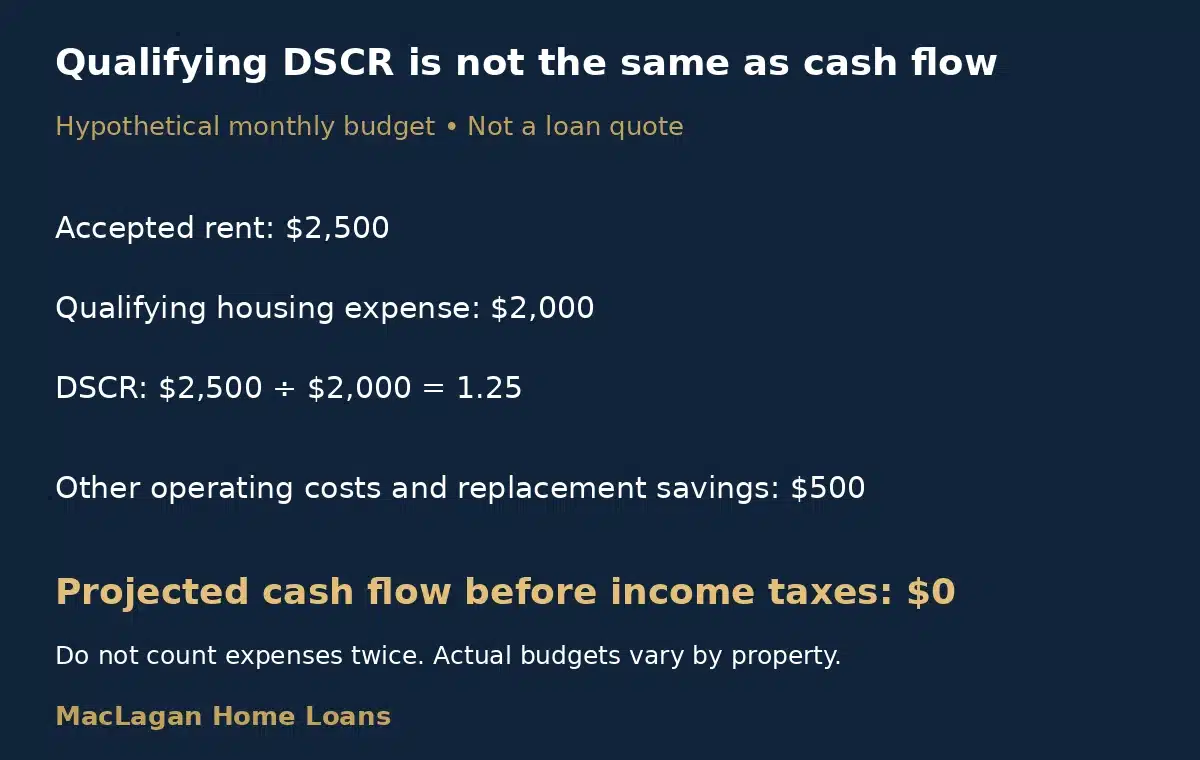
In a hypothetical example, $2,500 in accepted monthly rent divided by $2,000 in qualifying monthly housing expenses produces a DSCR of 1.25. If you also allocate $500 for operating costs and replacement savings not included in that payment, projected cash flow is $0 before income taxes. These are arithmetic assumptions, not an available mortgage quote or recommended expense allowance.
Do not count taxes or insurance twice if they are already included in the housing payment. For an owner occupied building, also separate tenant income from the personal benefit of living in your unit. A lender’s calculation may differ from your household budget.
There is no single cash flow target that fits every investor. Choose a goal based on the property’s condition, potential repairs, risk, and your available liquidity. Our DSCR calculation guide explains the qualification ratio in more detail.
Budget beyond the down payment
Plan for closing costs, prepaid expenses, any required reserves, and accessible funds for the property after closing. Having enough for the down payment alone does not mean you have enough to qualify or operate the rental comfortably.
As an illustration, a five percentage point increase in the required down payment on a $300,000 purchase uses another $15,000 of your funds. That additional contribution could change what you have available for repairs. It is one reason I check lender experience rules before an investor commits to a purchase budget.
Required reserves and an operating cushion serve related but different purposes. An account that qualifies for underwriting reserves may not be money you want to withdraw to replace a furnace. Our DSCR down payment, closing costs, and reserves guide walks through the full budget.
Five steps to compare your first rental financing
- Decide the intended occupancy. Confirm whether you will live in one unit or rent out the entire property.
- Review borrower eligibility. Discuss income, debts, credit, available assets, and previous homeownership or landlord experience.
- Check the property’s numbers. Review leases or comparable rents, the full housing payment, and a separate operating budget.
- Compare complete loan offers. Review down payment, rate, points, closing costs, reserves, mortgage insurance when applicable, and prepayment terms.
- Test your remaining cash. Confirm that the purchase leaves a workable cushion for vacancy and repairs before you commit.
Frequently asked questions
Do I need landlord experience to get a DSCR loan?
Not with every lender. Some programs accept first time investors, while others restrict eligibility or reduce maximum loan to value. Ask which definition of experience applies to your file.
Can I use FHA to buy a building and rent out every unit immediately?
Not under the primary residence purchase option discussed here. FHA financing requires the applicable owner occupancy conditions to be met. A building intended entirely for tenants needs an appropriate investment property loan.
Does 5% down conventional financing apply to every rental purchase?
No. The option discussed here concerns eligible two to four unit primary residence purchases. Conventional investment property loans have different down payment and underwriting requirements.
Will all of the property’s rent count toward qualification?
Not necessarily. Accepted rent, required documentation, and any adjustments depend on the program and circumstances. Do not assume a listing’s total projected rent can be used without review.
Is the lowest interest rate always the best loan for my first rental?
No. Compare total costs, payment structure, cash remaining after closing, and any early payoff restrictions. The best fit depends on your qualification and investment plan.
Plan Your First Rental Property Purchase
Considering your first rental or a two to four unit home you will live in? MacLagan Home Loans can compare financing around your occupancy plans, rental estimates, personal qualifications, and available cash. Book a call and bring the property details so we can review the numbers before you make an offer.
No SSN required. Zero impact to credit. Your information is never sold.
Explore our DSCR loan options for additional program information.
Educational information, not a loan commitment, rate quote, or guarantee of approval or investment returns. Down payment examples are subject to eligibility and exclude closing costs and reserves. Requirements vary by lender, borrower, property, and location and may change.

ABOUT THE AUTHOR
Alex MacLagan, Loan Officer
NMLS #1912744
Alex MacLagan is a mortgage loan officer with MacLagan Home Loans. Known to his clients as “Alex The Mortgage Doctor,” he works with first time buyers, move up buyers, self employed business owners, and real estate investors across Chicagoland and the north and northwest suburbs. Before lending, Alex spent years on the investing side of real estate with hands on experience across 100+ flips and rental properties, which shapes how he structures financing for clients today. When he’s not writing about mortgages or working with clients, you’ll find him with his fiancée and their dog.