

By Alex MacLagan | NMLS #1912744
A DSCR HELOC, a DSCR HELOAN, and a cash out refinance can each help an investor access rental property equity. The right choice depends on whether you want to keep your existing mortgage, how much money you need, and how you plan to repay it. Before comparing rates, confirm whether the new financing replaces your first mortgage or sits behind it.
For investors with an attractive existing mortgage, I start by comparing the cost of keeping that loan and adding a second mortgage against replacing the entire balance. Preserving a low rate can be valuable, but the payment and cost of the new financing still need to support your investment plan.
Can a DSCR HELOC preserve your existing mortgage?
Only a program that permits second lien financing can leave your existing first mortgage in place. The term DSCR HELOC describes how the financing qualifies and how funds are accessed; it does not automatically tell you the lien position. Some DSCR HELOC programs require first lien position.
For example, Sun West’s published DSCR HELOC guidelines describe a standalone first lien program. That structure would not preserve an existing first mortgage on the same property. This is a program example, not a statement that every lender follows the same rules.
A DSCR HELOAN can be a different option. Angel Oak’s DSCR second lien program describes a rental property loan that uses property cash flow to qualify while leaving the first mortgage in place. Availability and eligibility depend on the specific lender and property.
Ask two separate questions before proceeding: Does this program qualify using rental income, and can it close behind my existing mortgage? A yes to one does not establish the other.
What is the difference between a DSCR HELOC and a DSCR HELOAN?
A HELOC offers a revolving credit line, while a HELOAN provides a lump sum that is repaid under the loan’s terms. A DSCR version evaluates rental cash flow under the lender’s program rules. Neither product name guarantees a particular rate structure, lien position, or minimum qualification standard.
The CFPB’s explanation of home equity loans and lines distinguishes repeated borrowing from a single advance. HELOCs usually have adjustable rates. Home equity loans may have fixed or adjustable rates, so confirm the actual offer instead of assuming that every HELOAN has a fixed payment.
For an investor, the practical question is whether the money is needed all at once or in stages. Also confirm any required initial draw. A credit line that requires a substantial advance at closing may not work like an unused reserve account.
| Question | DSCR HELOC | DSCR HELOAN in second position | DSCR cash out refinance |
|---|---|---|---|
| How do you receive funds? | Draws within the approved line and contract terms | Lump sum at closing | Net cash after existing liens and transaction costs |
| Does it preserve the first mortgage? | Only if the program allows second lien position | Yes, subject to approval | No, it replaces the existing first mortgage |
| Can repaid principal be borrowed again? | Generally during the draw period, subject to restrictions | No automatic redraw | No automatic redraw |
| What should you compare? | Lien position, required draws, rate changes, and fees | Payment, term, fees, and payoff conditions | Cost of replacing the full balance and any payoff penalty |
When does keeping your first mortgage make sense?
Keeping the first mortgage may make sense when the combined cost of the existing loan and new second mortgage is more favorable than replacing the entire balance. Compare the amount of cash received, payments, fees, and remaining debt over the period you expect to keep the financing.
My recommendation is to protect an attractive existing mortgage when the alternative would reduce cash flow too much. I would still consider a new first mortgage if the overall numbers work and the next investment supports the additional financing cost. That requires reviewing both properties, not simply assuming the next purchase will offset a higher payment.
A blended interest rate is a useful starting point, but it is not a complete comparison. A lower required payment can reflect slower principal repayment. A shorter loan term can produce a higher payment while reducing the balance faster. Compare the dollars owed at your expected exit date as well as the monthly cash flow.
For the replacement mortgage option, our DSCR cash out refinance guide explains how valuation, existing debt, and loan costs affect proceeds.
How much rental equity can you actually access?
Your available financing depends on the lender’s accepted property value, permitted leverage, existing liens, and qualification rules. Equity on paper is not the same as cash available at closing. A lower appraisal or a rental income limitation can reduce the amount even when substantial equity exists.
For a proposed second mortgage, a preliminary calculation is accepted value multiplied by the allowed combined loan to value, minus existing mortgage debt. The lender must confirm how it counts other liens and any existing credit lines. Fees and payoff adjustments can reduce the usable proceeds further.
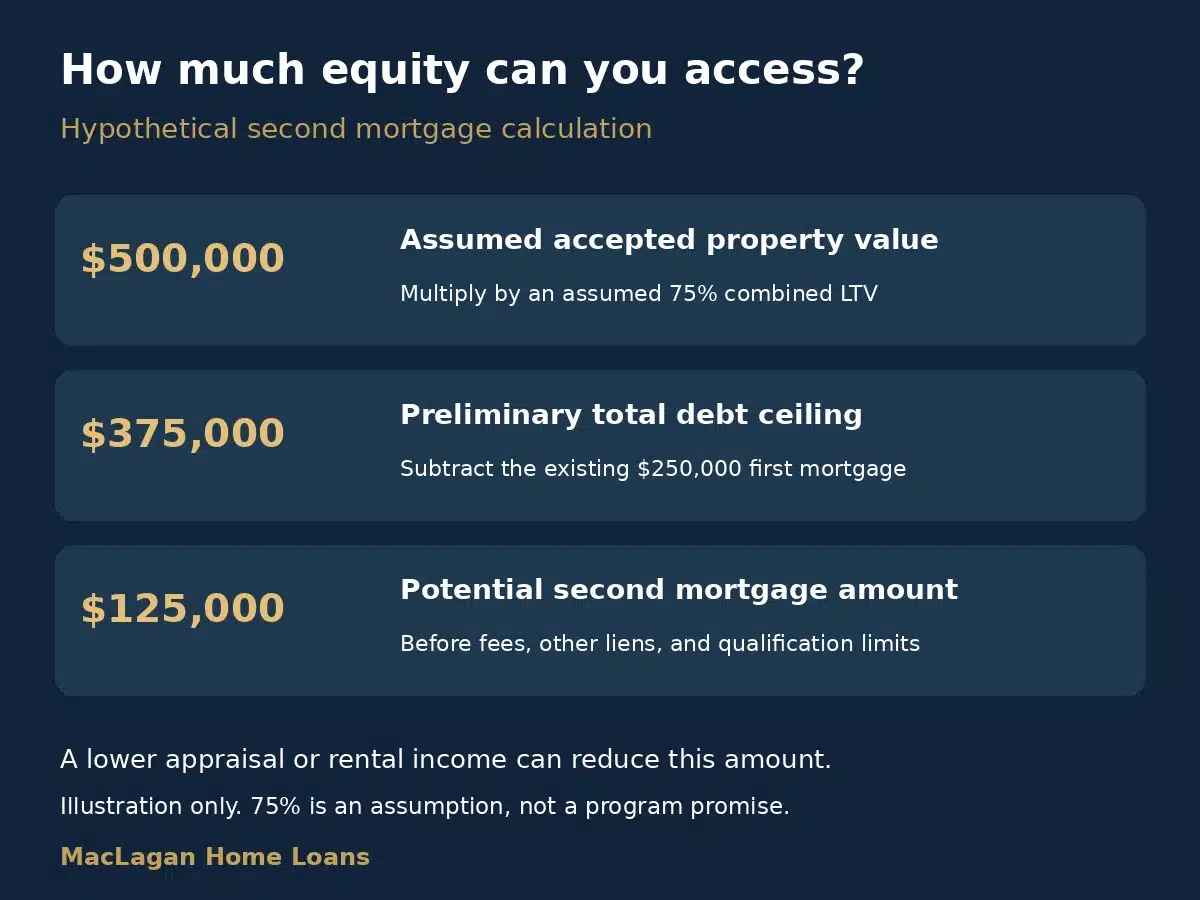
Consider a hypothetical rental valued at $500,000 with a $250,000 first mortgage. If a lender permits 75% combined loan to value, the preliminary total debt ceiling is $375,000. Subtracting the first mortgage leaves $125,000 for a potential second mortgage before fees and other limits. The 75% figure is an assumption for this illustration, not a universal program limit or approval.
If the accepted value instead comes in at $460,000, the same calculation produces $345,000 in total debt capacity and $95,000 for the second mortgage. That $40,000 change in value reduces preliminary borrowing capacity by $30,000. Rental qualification could limit it further.
How does rental income affect a DSCR second mortgage?
The lender must evaluate whether qualifying rent supports the debt obligations required by its program, including the existing first mortgage and proposed second mortgage where applicable. Do not calculate coverage using only the new second mortgage payment. Confirm the treatment of taxes, insurance, association dues, and the qualifying payment for a credit line.
My experience is that investors can overestimate available financing when they assume a rented property will qualify using higher market rent instead of the current lease. Review the actual lease and the lender’s rental income rules before committing the equity to another purchase.
For an illustrative calculation, suppose accepted rent is $3,000 monthly and the lender’s total qualifying housing expense is $2,500. The resulting ratio is 1.20. If that expense rises to $2,800, the ratio becomes approximately 1.07. These are examples of the calculation, not a statement that either ratio qualifies for a particular second mortgage.
Our guide to calculating DSCR on a rental property explains the underlying calculation. Each second lien or HELOC program still needs its own review.
Using equity to purchase and improve another rental
One strategy I discuss with investors is using a credit line for an eligible purchase or renovation, then refinancing the new property into longer term financing and using the proceeds to repay the line. If the line remains open and available, that may allow the investor to reuse the repaid borrowing capacity.
Plan the repayment before drawing funds. Confirm the future refinance’s property condition, rent, appraisal, seasoning, and proceeds requirements. The intended refinancing is a separate approval, not an automatic final step. Improvements do not guarantee a particular appraisal or enough proceeds to repay the line completely.
Keep a cash cushion for vacancies, repairs, and delays. Avoid describing this strategy as an infinite return or assuming it eliminates the need for cash. Borrowing against one rental to finance another connects the risk of the new project to the property securing the credit line.
Costs and terms beyond the interest rate
Compare upfront fees, ongoing charges, required draws, payment changes, and payoff terms alongside the interest rate. For a HELOC, read both the draw period and repayment provisions. For a cash out refinance, include any penalty owed on the existing mortgage as well as the new loan’s costs.
The CFPB’s HELOC overview explains that payments may increase after the draw period and that access to additional credit can be restricted. Its fee guide lists possible closing, annual, inactivity, and early cancellation charges. These consumer resources explain general mechanics; the actual business purpose investor loan documents control the offered terms.
Ask for a comparison using the same net cash amount and planned repayment date. Include an alternative scenario where the new purchase takes longer to rent or refinance. A strategy that works only with an immediate refinance leaves little room for an appraisal shortfall or unexpected repairs.
Five steps to compare rental equity financing
- Define the cash need. Identify the purchase, renovation, or other eligible investment expense and when funds are required.
- Review the existing mortgage. Gather the balance, rate, payment, remaining term, and any payoff penalty.
- Confirm program structure. Check lien position, rental qualification, permitted ownership, property eligibility, and available leverage.
- Compare complete costs. Use equal net proceeds and a common holding period to compare fees, payments, remaining balances, and payoff terms.
- Plan repayment and a backup. Evaluate how the debt will be repaid if a sale or refinance takes longer or produces less cash than expected.
Frequently asked questions
Can I get a DSCR HELOC on a property owned by an LLC?
Some programs allow entity ownership, but LLC eligibility must be confirmed for the specific HELOC or HELOAN. Ask about required entity documents, guarantors, and lien position before assuming an existing LLC qualifies.
Does a DSCR HELOC always leave my first mortgage unchanged?
No. Some DSCR HELOC programs require first lien position. Preserving your existing first mortgage requires an eligible second lien program and lender approval.
Is a DSCR HELOAN better if I need all the money immediately?
A HELOAN may suit a defined expense because it provides a lump sum. Compare the actual rate, payment, costs, and repayment terms against a HELOC or refinance before choosing.
Can I reuse the funds after paying down a DSCR HELOC?
Generally, principal repayments can restore borrowing capacity during the draw period if the line remains open and available under its terms. A HELOAN does not automatically provide that ability, and future HELOC access is not guaranteed.
Can I qualify for rental equity financing without personal tax returns?
Certain DSCR programs qualify using rental cash flow rather than personal income. That does not mean no documentation. Expect a lender review of the property, rents, credit, existing financing, and other program requirements.
Review Your Rental Property Equity Options
Want to access rental equity while evaluating whether to keep your current mortgage? MacLagan Home Loans can compare available DSCR HELOC, HELOAN, and cash out refinance options around your property, cash needs, and repayment plan. Bring your current mortgage statement, lease information, and investment goals to the conversation.
No SSN required. Zero impact to credit. Your information is never sold.
Explore our DSCR loan options for additional program information.
Educational information, not a loan commitment or rate quote. Programs and terms vary by lender, property, borrower, and location and may change. Business purpose investor financing is subject to underwriting and applicable requirements. Examples are hypothetical. Borrowing against a property puts it at risk if the debt is not repaid.

ABOUT THE AUTHOR
Alex MacLagan, Loan Officer
NMLS #1912744
Alex MacLagan is a mortgage loan officer with MacLagan Home Loans, licensed in Illinois, Wisconsin, Arizona, and Minnesota. Known to his clients as “Alex The Mortgage Doctor,” he works with first time buyers, move up buyers, self employed business owners, and real estate investors across Chicagoland and the north and northwest suburbs. Before lending, Alex spent years on the investing side of real estate with hands on experience across 100+ flips and rental properties, which shapes how he structures financing for clients today. When he’s not writing about mortgages or working with clients, you’ll find him with his fiancée and their dog.