
Yes, self employed borrowers can qualify for an FHA loan. The important question is how much income the lender can document and use. That can differ from how much money your business brings in.
For an Illinois business owner, that review is worth doing before you choose a home price range. In my experience, borrowers are often surprised when their qualifying monthly income comes out lower than expected after business deductions. A successful business and a mortgage ready income calculation can look very different.
This guide explains what to gather, how income is evaluated, and when I recommend comparing FHA with another financing option.
How long do you need to be self employed for an FHA loan?
FHA generally requires two years of self employment. One to two years may qualify when the borrower previously worked for at least two years in the same or a related occupation. FHA defines self employment income as income from a business in which you own at least 25%. See HUD’s self employment requirements.
Before requesting a long list of documents, I want to understand your work: what you do, how your business files taxes, your ownership share, and which returns are already filed. Those questions give the document review a useful starting point.
What documents should a self employed borrower gather for FHA preapproval?
My starting checklist is a government issued ID, the last two months of bank statements, two years of complete federal personal tax returns, and a current year to date profit and loss statement. For an S corporation owner, I also request two years of business returns and shareholder schedules. This is my preparation checklist; the lender determines the final requirements.
| Document | Sole proprietor | S corporation owner |
|---|---|---|
| Driver’s license or government issued ID | Gather | Gather |
| Last two months of bank statements | Include all pages | Include all pages |
| Last two years of federal Form 1040 returns | Include every page and schedule | Include every page and schedule |
| Current year to date profit and loss statement | Gather | Gather |
| Last two years of business income tax returns | Business income is generally reported on Schedule C | Gather Form 1120S returns |
| Last two years of shareholder schedule | Generally not applicable to a sole proprietorship | Gather shareholder schedules |
The IRS identifies Schedule C as the form used to report a sole proprietorship’s business profit or loss. For S corporations, Form 1120S and its shareholder schedules provide different pieces of the business income picture.
Save complete PDFs rather than screenshots of just the first page. My request for “all pages and schedules” is deliberate: I need the supporting information before I can give you a useful income estimate. You can also read about the mortgage preapproval process before gathering your documents.
Does a sole proprietor or LLC owner need separate business tax returns?
A sole proprietor generally reports business income on Schedule C attached to the personal return, rather than a separate corporate income tax return. An LLC’s requirements depend on how it is taxed: a single member LLC may report through its owner’s return, while an LLC taxed as an S corporation files differently. The IRS explains the different LLC tax classifications.
Tell your loan officer how you file, instead of only saying “I have an LLC.” If you are unsure, ask your accountant which tax forms report your business income. That is a straightforward way to avoid searching for a corporate return that your business does not file.
FHA permits a business return exception under specified conditions. A lender may still request business returns to complete its review; ask which documents are required for your file rather than assuming the exception applies.
How is self employed income calculated for an FHA loan?
The lender analyzes tax returns and allowable adjustments. FHA uses the lower of the applicable two year average or the previous one year average. Certain deductions, such as eligible depreciation, may be added back; it is not simply Form 1040 adjusted gross income divided by 12. These rules appear in HUD’s income section and Appendix 2.0.
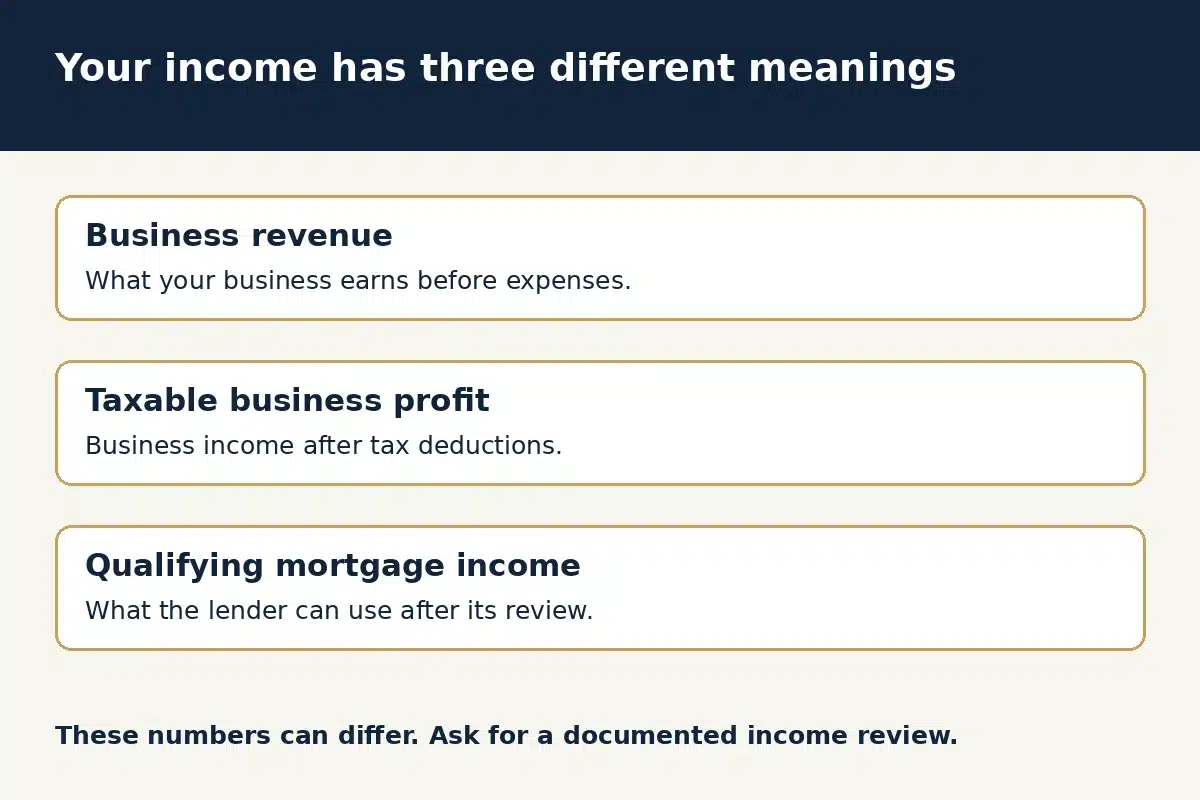
The surprise I hear from borrowers is usually this: “My business makes more than that.” Business revenue, taxable profit, and qualifying mortgage income are different figures. My job is to review the documents and explain which number we can use for the mortgage.
Illustrative example: Suppose the completed income analysis produces $60,000 of qualifying self employment income for one year and $84,000 for the next. The two year average is $72,000, or $6,000 per month. The latest year figure is $7,000 per month, so the lower figure is $6,000 before any additional stability review.
This example assumes a full two year history and already adjusted qualifying income. It does not start with gross deposits or the AGI line, and it is not an approval or purchase price estimate.
Can an unfiled tax return affect your homebuying budget?
It can, especially when your most recent completed tax year was stronger and you want that income considered. In my experience, an unfiled return is one of the most common obstacles to getting the income review and homebuying budget where a borrower expects them to be.
By “most recent year,” I mean the latest completed tax year, not an unfinished year whose annual return is not yet due. During 2026, that will commonly mean the 2025 return.
If you filed an extension, tell me early and share its status with your accountant. An extension does not automatically rule out financing, but we need to determine what documentation the lender can accept. A draft showing higher income should not be treated as an approved increase in your budget.
The IRS explains that an extension gives more time to file, not more time to pay taxes owed. Coordinate filing decisions with your tax professional rather than changing your tax strategy solely to pursue a particular mortgage amount.
Do you need a current P&L and balance sheet?
FHA requires a year to date P&L and balance sheet when more than a calendar quarter has passed since the latest tax period end. Schedule C filers are exempt from that balance sheet requirement. See HUD’s documentation rules.
My practical advice is to get your current P&L from your accountant before applying. I request it at the beginning because I want the current business picture alongside the filed returns. Tell your accountant the period needed and provide up to date bookkeeping records so the statement is useful.
Do not wait until you find a house to start that conversation. Gathering it early lets us identify questions while you still have time to respond.
What if your business income has declined?
A decline can reduce qualifying income and require further review. Under FHA’s automated underwriting rules, a decline greater than 20% over the analysis period requires a downgrade to manual underwriting. A higher older year does not automatically offset a weaker recent year. See HUD’s stability of income requirements.
Raise changes early, whether they involve lost contracts, a quieter season, or a change in how the business operates. The useful next step is to review the actual numbers and documentation together, rather than guessing what a lender will accept.
Comparing FHA, conventional, and bank statement financing
I recommend looking at another option when the documented income does not support the home the borrower wants, or when a different program may offer a better overall cost. That comparison starts with the borrower’s goals and documents, not a program label.
Conventional financing: I tend to compare conventional with FHA when a borrower has stronger credit and a lower debt to income ratio. The CFPB explains that conventional PMI is generally cheaper for borrowers with good credit. FHA includes upfront and ongoing mortgage insurance; conventional PMI arrangements vary, and some include upfront premiums. Compare actual loan estimates, monthly costs, and the expected time you will keep the loan.
Bank statement financing: I recommend exploring this when tax return based qualifying income puts the desired purchase price out of reach. Some lenders analyze eligible personal or business deposits over 12 or 24 months. That does not mean every deposit counts as income or that expenses disappear. For example, Angel Oak describes eligible deposit analysis and a business expense factor. Terms depend on the lender and program.
You can explore our Illinois bank statement mortgage guide for that separate path. A bank statement mortgage is an alternative to FHA, not a way to replace FHA’s documentation rules with bank deposits.

Your preparation plan before house hunting
Start with the current P&L. That is my most useful preparation recommendation for a self employed borrower who is getting ready to apply. Ask your accountant for it while gathering the complete personal returns and any business returns and shareholder schedules that apply.
Next, put your documents in one folder and make a short list of questions: Which years are filed? How is the business taxed? Has income changed? What monthly housing payment feels comfortable? Send the documents through the secure process your loan officer provides.
I would rather work through those questions before you commit to a price range than discover an income gap after you fall in love with a house. A clear early review gives us a better basis for deciding whether to pursue FHA, compare conventional financing, or evaluate a bank statement option.
Frequently asked questions about FHA loans for self employed borrowers
Can I get an FHA loan without two years of self employment?
Possibly. FHA generally requires two years of self employment, but one to two years may qualify if you previously worked for at least two years in the same or a related occupation. A newly opened business does not automatically qualify. Review your work history with your loan officer. See HUD’s employment history rules.
Can I use bank statements instead of tax returns for an FHA loan?
Bank statements alone do not replace the tax return review for FHA self employment income. Statements help document assets and other parts of the application. If you need financing based on eligible deposits, ask about a separate bank statement mortgage and compare its costs and requirements with FHA.
Does FHA use gross business revenue or net income for self employed borrowers?
FHA does not simply use gross business revenue. The lender analyzes documented income, applies permitted adjustments, and uses the lower of the applicable two year average or previous one year average. Business deposits and Form 1040 adjusted gross income are not automatic substitutes for that calculation. See HUD’s income calculation rules.
Can tax write offs lower the amount I qualify for on an FHA loan?
Yes. Business deductions can lower the income available for mortgage qualification, although certain eligible deductions, such as depreciation, may be added back. Not every write off qualifies for an adjustment. Have your loan officer review the complete returns before setting a purchase budget. See HUD’s self employment income adjustments.
Does a sole proprietor need a balance sheet for an FHA loan?
FHA does not require a balance sheet for borrowers reporting Schedule C income. A current year to date profit and loss statement is required when more than a calendar quarter has passed since the latest tax period ended. Ask your accountant for current records early, and confirm any additional lender requirements. See HUD’s documentation rules.
Get Started On Your FHA Loan Today!
Answer a few simple questions to find out what you qualify for. It takes less than 1 minute.
No SSN required. Zero impact to credit. Your information is never sold.
Learn more about FHA loans in Illinois.
Educational information, not a commitment to lend. Eligibility, documentation, pricing, and final approval depend on the complete application, underwriting, lender requirements, and property. Guidance checked October 1, 2026.