
By Alex MacLagan | NMLS #1912744
When you use the BRRRR method, plan the refinance before you buy the property. Estimate the long term loan amount, full mortgage payment, and rental cash flow first. Then work backward to a purchase price and renovation budget that fit your goals. A successful renovation does not guarantee a refinance that returns all your cash.
BRRRR means buy, rehab, rent, refinance, and repeat. A DSCR loan can provide the rental financing at the refinance stage for an eligible investment property. My advice to investors is simple: decide whether the finished property works as a rental before committing to the acquisition.
How does a DSCR loan fit into the BRRRR strategy?
A DSCR loan may replace the financing used to purchase and renovate a property once it meets the rental lender’s requirements. Qualification focuses on the property’s accepted rental income relative to its qualifying payment, along with credit, equity, assets, property eligibility, and other program rules.
The acquisition loan and the rental refinance are separate decisions. Approval for a rehab loan does not establish approval for the future DSCR loan. The property’s condition, value, rents, and your financial situation can change between those two closings.
If you are buying a property that needs work, our fix and flip financing page explains the acquisition and renovation side. Even when you intend to keep the home, the short term loan still needs a realistic repayment plan. Check its maturity date, extension terms, and payoff charges before closing.
Why should you work backward from the refinance?
Working backward shows whether the finished rental can support the proposed debt and your minimum cash flow. If it cannot, you can revisit the purchase price, renovation scope, financing, or cash invested before buying. After closing, those choices may be harder or more expensive to change.
When I review a BRRRR project, I start with the estimated long term loan and payment. We then look at what the investor expects to collect in rent and what it will cost to operate the property. If the cash flow falls short, we work on the purchase and renovation numbers upfront.
This is a planning exercise rather than a future rate lock or approval. Use a realistic base case and a less favorable case with lower rents, higher expenses, or a smaller refinance. If the project only works under the most optimistic assumptions, it needs a closer look.
How do you estimate the mortgage payment and rental cash flow?
Build the payment from the proposed loan terms and all required housing expenses. Then prepare a separate operating budget that includes costs the lender’s DSCR calculation may not capture. Meeting a lender’s ratio does not necessarily mean the property meets your cash flow target.
Include principal and interest when applicable, property taxes, landlord insurance, and any association dues. Confirm the payment structure, amortization, and whether an interest only period later ends. Do not reuse the rehab loan’s payment as an estimate for the permanent mortgage.
For your investment analysis, also allow for vacancy, maintenance, management, owner paid utilities, and major replacements. Avoid counting taxes or insurance twice if they are already included in the housing payment. Consider future tax changes and obtain an insurance estimate for the finished rental.
For example, assume $3,000 in accepted monthly rent and a $2,400 qualifying housing expense. That produces a DSCR of 1.25. If you also budget $600 monthly for vacancy, maintenance, management, and replacements, projected cash flow is $0 before income taxes. These are hypothetical arithmetic assumptions, not an advertised mortgage payment or recommended expense allowance.
Our DSCR calculation guide explains why accepted rent and payment components matter. Existing leases, market rent conclusions, and vacant units must be evaluated under the selected program. A listing’s projected rent is not a lender decision.
Estimating the cash recovered at refinancing
Estimate the available loan first, then subtract the existing debt payoff and refinance costs. The amount left may be available to you, subject to program restrictions and closing adjustments. The new loan amount itself is not the amount of cash you receive.
The approved loan can be limited by appraised value, allowed loan to value, rental qualification, seasoning, and other underwriting conditions. A property with sufficient equity may still support less debt than you expected if accepted rent or loan terms change.
Use an actual payoff estimate when available. The amount needed to retire the rehab loan may include accrued interest, funded draws, fees, or other charges beyond the balance you initially borrowed. Separately estimate refinance charges, prepaid items, and any escrow deposits.
Track your own cash contributions throughout the project. Cash returned through borrowing is not automatically profit. To estimate unrecovered cash invested, compare the net proceeds with your documented cash invested in the purchase, renovation, and carrying costs. Do not count a lender funded renovation expense as your own cash contribution too.
A lower appraisal can change the entire exit plan
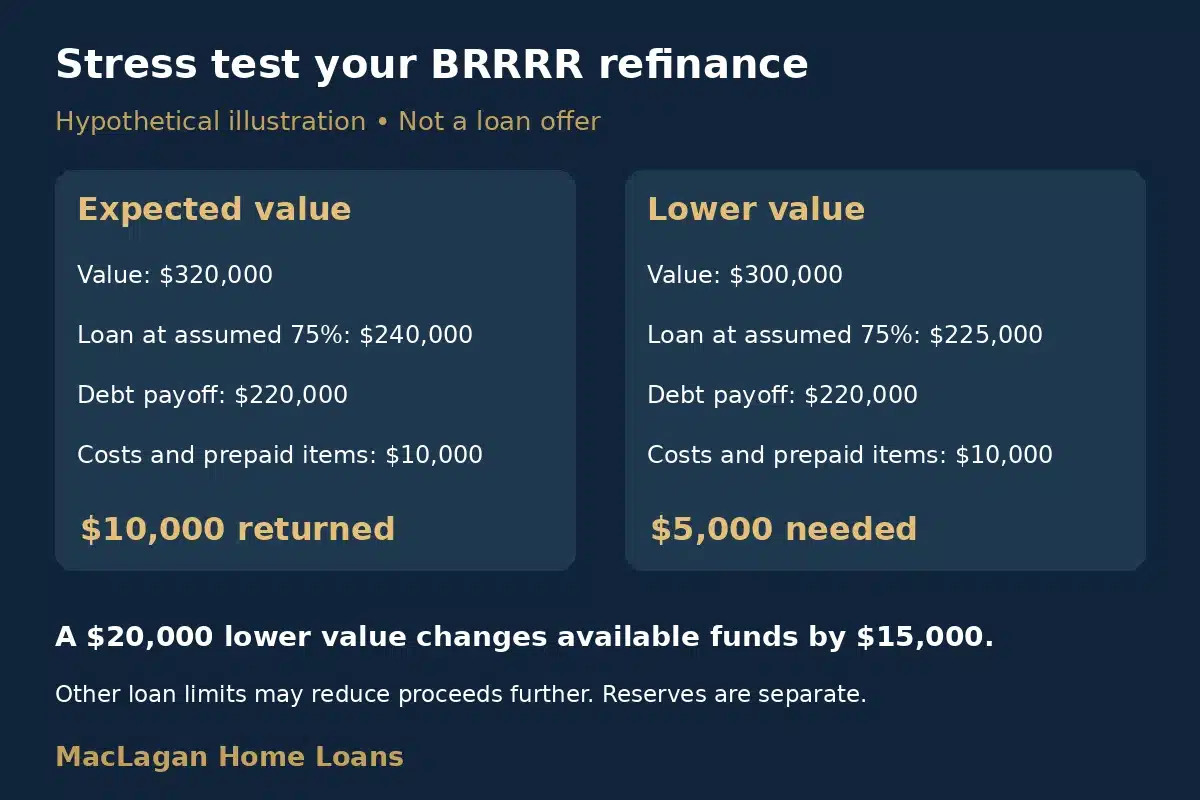
Consider this hypothetical refinance with an assumed 75% loan to value limit. This percentage is an example, not a program offer. Both scenarios assume the property satisfies every other requirement, a $220,000 debt payoff, and $10,000 of refinance costs and prepaid items paid from the transaction.
| Item | Expected value scenario | Lower value scenario |
|---|---|---|
| Appraised value | $320,000 | $300,000 |
| Assumed loan to value limit | 75% | 75% |
| Loan based on value alone | $240,000 | $225,000 |
| Existing debt payoff | $220,000 | $220,000 |
| Refinance costs and prepaid items | $10,000 | $10,000 |
| Net transaction result | $10,000 returned | $5,000 needed to close |
A $20,000 difference in appraised value reduces the assumed loan by $15,000. The investor moves from receiving $10,000 to needing $5,000 at closing. Rental qualification or other loan limits could reduce the available amount further.
If the investor had already contributed $50,000 in personal funds to the project, the first scenario would leave $40,000 unrecovered. The second would increase that amount to $55,000 after the additional contribution. Those figures measure cash invested, not current equity, taxable profit, or total investment return. Required reserves and an operating cushion are separate from this simplified settlement example.
What mistakes can prevent the refinance from working as planned?
The biggest mistakes I see are using the wrong mortgage payment, overestimating the after repair value, and assuming more cash will come back than the refinance can provide. These errors can leave an investor bringing money to closing or keeping more capital in the property than planned.
Treat the after repair value as an estimate supported by comparable sales, not a promised appraisal result. Renovation spending does not necessarily increase value dollar for dollar. Build a budget that still has room for surprises if the final valuation is lower.
Keep the purchase settlement statement, renovation invoices, draw records, and evidence of completed work. These records help explain the project and support lender review, but they do not dictate the appraiser’s opinion of value.
Timing also matters. In its guidance on refinancing a hard money loan, Visio highlights completed property condition, payment history, and ownership seasoning as issues to review. Confirm current requirements with the chosen lender and start planning early enough to address problems before the rehab loan matures.
Can you refinance without waiting six months?
Some DSCR programs offer shorter seasoning or no seasoning options for eligible transactions. That does not mean every renovated property qualifies immediately or that the lender will always use your projected value. Ownership time, loan purpose, property condition, occupancy, and the permitted valuation basis all need review.
For a current example of how specific these rules can be, Kiavi’s rental loan page describes cash out after 90 days, with immediate options for certain Kiavi bridge loans or properties owned free and clear. That is one lender’s published product description, not a universal rule or a commitment for your transaction.
I also work with lenders offering no seasoning cash out options, as discussed in our DSCR cash out refinance guide. We still need to confirm the applicable conditions. A shorter ownership requirement does not eliminate appraisal, title, documentation, or underwriting time.
Ask whether the refinance is treated as cash out or another refinance type and whether recent acquisition cost limits the usable value. Build enough room into the rehab loan timeline for completion, leasing when required, and the refinance process. An extension should not be assumed to be automatic.
When should you leave more equity in the property?
I recommend considering a smaller refinance when the larger loan would not produce enough cash flow or when leaving more equity creates a worthwhile pricing improvement. Compare actual offers and projected operating results rather than assuming the maximum available loan is the best choice.
A smaller balance may lower the payment and improve the DSCR. It may also place the loan in a more favorable loan to value pricing tier, depending on the lender. There is no guarantee that every reduction in the loan amount changes the rate.
Review the tradeoff in dollars: how much less cash comes back, how much the payment changes, what fees or points differ, and how much accessible cash remains outside the property. Equity is not the same as money available for a repair next week. Keep an operating cushion while deciding how much to reinvest in the next deal.
Five steps to plan your BRRRR financing
- Set the rental target. Estimate supportable rent, operating expenses, and your minimum cash flow after the property is renovated.
- Model the permanent loan. Review the expected loan amount, full payment, rental qualification, and applicable refinance conditions before buying.
- Work backward to the acquisition. Compare the refinance outcome with the purchase price, renovation budget, carrying costs, and your available cash.
- Test a less favorable outcome. Recalculate using a lower appraisal, reduced rent, higher costs, or a delayed closing and identify how you would cover the difference.
- Review the exit before committing. Confirm the rehab loan maturity and payoff terms, refinance timing, required documents, and whether leaving more equity better serves your investment goals.
Frequently asked questions
Does a rehab loan approval guarantee the DSCR refinance?
No. The refinance is a separate loan decision. The rental lender must review the finished property, accepted rents, value, borrower qualifications, and its current program requirements.
Will a BRRRR refinance return all my invested cash?
Not necessarily. The loan must cover the existing debt and transaction costs before producing proceeds for you. A lower value, smaller approved loan, or higher payoff can reduce cash returned or require additional funds at closing.
Can I use my expected after repair value as the refinance value?
You can use it for preliminary planning, but the lender determines the acceptable valuation basis and appraisal requirements. Your renovation budget and estimated resale value do not guarantee the final loan amount.
Do I need a tenant before the DSCR refinance closes?
It depends on the program. Ask about lease, occupancy, and market rent requirements before setting your timeline. Do not assume a vacant property and an occupied property receive identical treatment.
Should I take the largest DSCR loan I qualify for?
Not automatically. Compare the cash recovered with the payment, pricing, operating cash flow, and remaining liquidity. A smaller loan may better meet your goals even if it leaves more money invested in the property.
Plan Your BRRRR Financing Before You Buy
Have a rental renovation project in mind? MacLagan Home Loans can help you work backward from the expected DSCR refinance. Bring the property address, purchase price, renovation budget, expected rents, and your cash flow goal so we can compare the acquisition and long term financing together.
No SSN required. Zero impact to credit. Your information is never sold.
Explore our DSCR loan options for additional program information.
Educational information, not a loan commitment, rate quote, or guarantee of approval or investment returns. Examples are hypothetical. Loan terms and eligibility vary by lender, borrower, property, and location. Borrowing against a property creates repayment obligations and puts the property at risk if the debt is not repaid.

ABOUT THE AUTHOR
Alex MacLagan, Loan Officer
NMLS #1912744
Alex MacLagan is a mortgage loan officer with MacLagan Home Loans. Known to his clients as “Alex The Mortgage Doctor,” he works with first time buyers, move up buyers, self employed business owners, and real estate investors across Chicagoland and the north and northwest suburbs. Before lending, Alex spent years on the investing side of real estate with hands on experience across 100+ flips and rental properties, which shapes how he structures financing for clients today. When he’s not writing about mortgages or working with clients, you’ll find him with his fiancée and their dog.