

By Alex MacLagan, Loan Officer | NMLS #1912744
Bank statement loan income is generally calculated by reviewing eligible deposits over an approved period and applying the lender’s required adjustments. For business accounts, those adjustments commonly include an expense factor. Your total deposits are not automatically your qualifying mortgage income.
For a self employed buyer, the useful question is not simply, “How much went into my account?” It is, “How much of that money can this lender use, under this program?”
At MacLagan Home Loans, I review the accounts, business type, documentation, and statement period before estimating a purchasing budget. The account you choose and the expenses the lender recognizes can make a meaningful difference.
What is the basic bank statement income calculation?
A simplified business account calculation starts with eligible deposits, divides them by the number of months reviewed, and subtracts the applicable expense percentage. Business ownership and other program adjustments may also affect the result.
Average eligible monthly deposits × income percentage retained = illustrative monthly qualifying income.
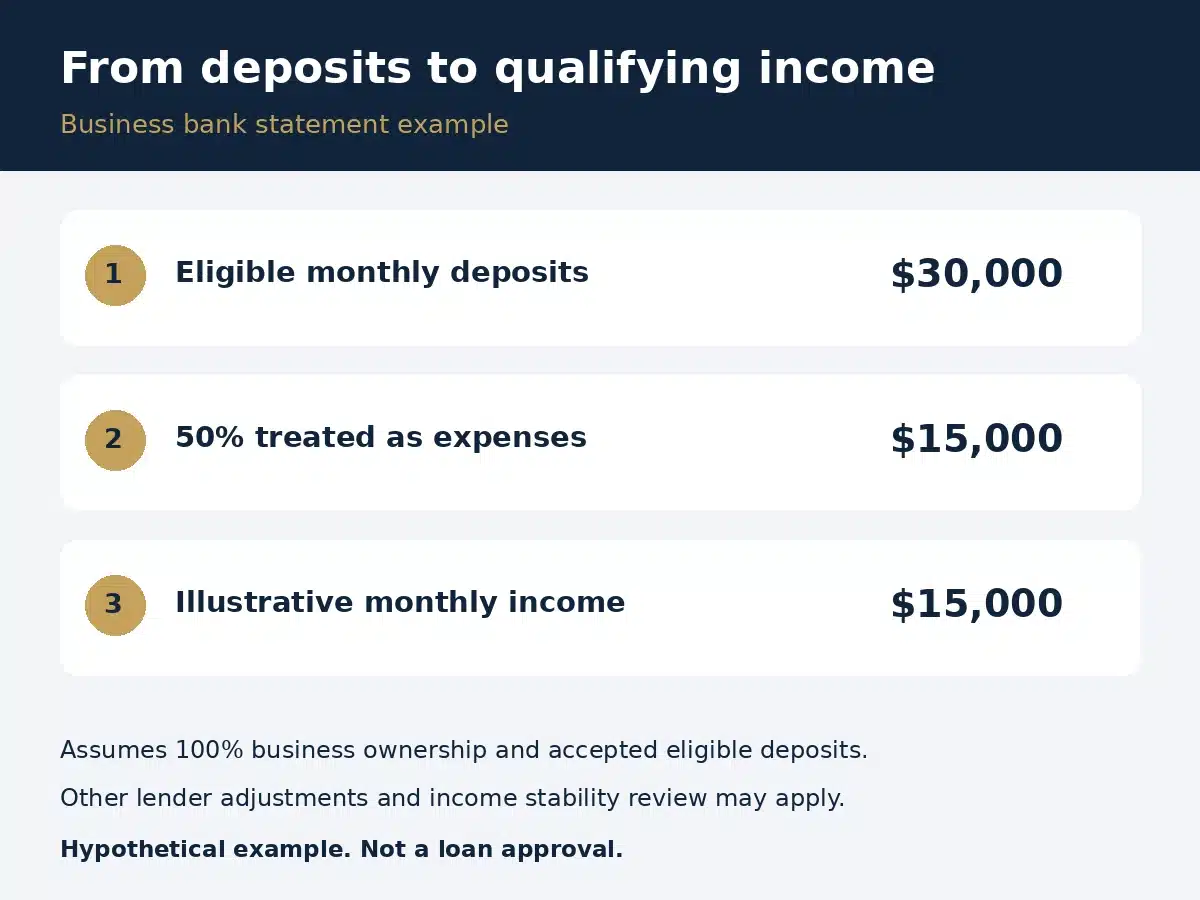
Suppose a borrower who owns the entire business has $360,000 in eligible deposits over 12 months. The average is $30,000 per month. If the lender applies a 50% expense factor, the remaining income is $15,000 per month.
That example assumes every deposit included has already been reviewed and the lender accepts the income history. It is an illustration, not an approval or a universal underwriting formula.
Our Illinois bank statement mortgage requirements guide covers the broader preparation process. This article focuses on understanding the income number.
What does a 50% expense factor mean?
An expense factor is the portion of eligible business deposits treated as business operating expenses. A 50% expense factor leaves 50% available for the income calculation, before any additional adjustments.
In my experience, business statement programs commonly start at 50%, depending on the industry and company type. A business with substantial payroll, inventory, or other operating costs may be evaluated differently from one with lower overhead.
Do not assume the default percentage describes your actual profit. Ask which method the proposed lender uses and what documentation it accepts to support the business’s expenses.
Can a CPA expense letter increase qualifying income?
A lender accepted expense letter can support a lower expense factor when the business records justify it. In some programs, a 10% expense factor can leave as much as 90% of eligible deposits available for the calculation. That is a program option, not a percentage every business can obtain.
Defy’s published program information provides an example of a lender offering an expense factor as low as 10% with a supporting CPA letter. Other lenders have different minimums and documentation rules.
Here is a hypothetical comparison using $30,000 in average eligible monthly business deposits and 100% business ownership:
| Expense factor | Percentage retained as income | Illustrative monthly income |
| 50% | 50% | $15,000 |
| 30% | 70% | $21,000 |
| 10% | 90% | $27,000 |
These figures show the arithmetic, not three choices a borrower can freely select. The letter must reflect supportable expenses, meet the lender’s requirements, and be accepted in underwriting.
Before asking your CPA to prepare a letter, let your loan officer confirm its required contents and who may prepare it. That can prevent paying for a document the lender cannot use.
Which deposits may be excluded from income?
The lender needs to distinguish business income from money that entered the account for another reason. A transfer, borrowed funds, or an owner contribution should not automatically be treated as customer revenue.
In my reviews, deposits unrelated to the business are a common source of questions. Labeling a transaction clearly and keeping its supporting records can help explain it. Moving the same money between accounts does not create additional income.
Give your loan officer a description of how customers pay you and which accounts receive those payments. If there are several accounts, disclose them so the review can address the entire flow of funds without counting the same revenue twice.
What if one unusually large deposit is business revenue?
An unusually large deposit deserves attention even when it represents legitimate work. If you want it considered as income, be ready to document its source and business purpose.
My recommendation is to gather the related invoice, contract, payment record, or other available evidence before underwriting asks about it. The exact documents needed depend on the transaction and lender.
Documenting the source does not guarantee inclusion. The lender may still evaluate whether the income is appropriate for the program and consistent with the business’s ongoing activity. Raise unusual transactions early so your budget does not rely on an unreviewed deposit.
Are personal and business bank statements calculated the same way?
Not necessarily. Business accounts may contain revenue before expenses, while a personal account may receive distributions after business expenses. Programs can apply different methods to these account types.
Angel Oak describes programs using personal or business statements over 12 or 24 months, including business expense adjustments and documentation for certain lower expense factors.
The account label alone does not establish qualifying income. Ask which deposits are eligible, whether an expense adjustment applies, and how the lender handles transfers and business ownership. Do not assume every personal deposit counts or submit only the account with the largest balance.
When can 24 months of statements help more than 12?
I compare 24 months when the additional history may improve the accepted monthly income or when the lender offers a pricing benefit for longer documentation. I also consider whether the older period introduces questions about the business’s current income.
Consider this hypothetical example, using monthly qualifying income after eligible deposits and expenses have been evaluated:
| Period | Average monthly income |
| Most recent 12 months | $22,000 |
| Previous 12 months | $35,000 |
| Combined 24 month average | $28,500 |
Because each period covers 12 months, their combined average is ($22,000 + $35,000) ÷ 2 = $28,500. That is $6,500 more per month than the latest 12 month figure.
There is an important underwriting question in this example: the latest year is lower than the earlier year. The lender must evaluate that decline. A higher historical average does not automatically establish acceptable current income, and the program may require a different calculation or additional review.
For a growing business, older lower income could instead reduce the average. Compare the permitted methods rather than assuming more statements always help.
Can 24 months of statements help your interest rate?
Some lenders I work with offer slightly better pricing for 24 months compared with 12 months. Separately, a higher accepted qualifying income can lower your debt to income ratio for the same debts, which may affect eligibility or pricing under certain programs.
For illustration, $9,000 in total monthly housing and other qualifying debts divided by $22,000 of income produces a ratio of about 40.9%. Using $28,500 produces about 31.6%.
That does not promise a lower rate. Credit, down payment, loan size, property, and the lender’s pricing rules also matter. Compare actual options using income the lender can accept, rather than choosing a statement period based only on its apparent average.
Should you compare a bank statement loan with FHA or conventional financing?
Yes. A bank statement mortgage can be worth exploring when tax return based qualifying income does not support the home you want. It should still be compared with other available financing on overall cost, cash needed, and your goals.
If your documented income supports FHA or conventional financing, review those options too. Our self employed FHA loan guide explains that separate income review. A bank statement program does not replace FHA’s documentation rules.
What should you prepare before an income review?
Gather complete statements with every page for the requested period. Identify the business ownership, how customers pay you, and any transfers or unusual deposits. Tell your loan officer whether your income has changed and whether your CPA can document actual operating expenses.
My goal is to explain the usable monthly income before you commit to a price range. An early review gives us time to compare accounts, documentation periods, and lender requirements while you still have flexibility.
Frequently asked questions
Does a bank statement loan count every deposit as income?
No. Deposits must meet the lender’s income requirements. Transactions unrelated to business revenue, transfers, and borrowed funds may be excluded. Business expenses and other program adjustments can reduce the amount used.
Does a 50% expense factor mean only half my income counts?
It means half of the eligible business deposits are treated as expenses under that calculation. The remaining half is used before any additional adjustments. It does not establish your actual accounting profit or mean half of every deposit automatically qualifies.
Can a CPA letter allow 90% of business deposits to count?
Some programs permit a supported 10% expense factor, leaving 90% of eligible deposits for the calculation. The business must justify its expenses and meet the lender’s rules. A CPA letter does not guarantee that percentage or loan approval.
Are 24 months of bank statements always better than 12?
No. The result depends on eligible income in each period, the lender’s rules, and income stability. Longer documentation can improve an average or offer a pricing benefit with some lenders, but older lower income can reduce the average. A recent decline still requires review.
Can a large business deposit count toward qualifying income?
It may, if its source and purpose are documented and the lender accepts it under the program. Prepare the supporting records early. A deposit being real business revenue does not by itself guarantee that underwriting will include it.
Get Started On Your Bank Statement Loan Today!
Self employed? Explore mortgage options using your eligible bank deposits. Answer a few simple questions in less than 1 minute to get started.
No SSN required. Zero impact to credit. Your information is never sold.
Educational information, not a commitment to lend. Income calculations, documentation, pricing, and approval depend on the lender, program, full application, and property. Examples are hypothetical. Information reviewed October 3, 2026.

ABOUT THE AUTHOR
Alex MacLagan, Loan Officer
NMLS #1912744
Alex MacLagan is a mortgage loan officer with MacLagan Home Loans, licensed in Illinois, Wisconsin, Arizona, and Minnesota. Known to his clients as “Alex The Mortgage Doctor,” he works with first time buyers, move up buyers, self employed business owners, and real estate investors across Chicagoland and the north and northwest suburbs. Before lending, Alex spent years on the investing side of real estate with hands on experience across 100+ flips and rental properties, which shapes how he structures financing for clients today. When he’s not writing about mortgages or working with clients, you’ll find him with his fiancée and their dog.