
By Alex MacLagan | NMLS #1912744
Yes. Self employed homeowners may qualify for a traditional HELOC or a bank statement HELOC, depending on their income, credit, equity, and the lender’s requirements. A bank statement program can help when tax deductions reduce the income available for traditional qualification. It changes how income is documented and calculated; it does not remove the need to qualify.
Why can tax write offs make a traditional HELOC harder to qualify for?
Business deductions can reduce the income a lender recognizes, which can push your debt to income ratio above its limit. That ratio compares your required monthly debt payments with qualifying monthly income. A healthy bank balance or strong sales does not automatically solve an income qualification problem.
In my work with self employed borrowers, this is a common reason a traditional HELOC does not work. After the lender analyzes the tax returns, the income may be too low to support the existing debts and proposed payment. Some expenses may receive permitted adjustments, so qualifying income is not always identical to the adjusted gross income on a tax return.
A bank statement HELOC is an alternative worth reviewing when that calculation is the obstacle. It is not an automatic approval or a reason to borrow more than your business and household can comfortably repay.
How does a bank statement HELOC calculate income?
The lender reviews eligible deposits over an approved statement period and applies its rules for expenses, business ownership, and income stability. Most programs I work with require at least 12 months of personal or business statements. Some offer a 24 month review.
Angel Oak’s published bank statement HELOC program, for example, lists both 12 and 24 month options. That confirms the approach exists, but its requirements are not rules for every lender or a promise that a particular program is available for your property.
The starting point is eligible income deposits, not every dollar entering the account. Transfers between your own accounts, loan proceeds, and unrelated deposits should not be counted as new business earnings. An unusually large business deposit may need invoices or other records showing its source and whether it represents ongoing income.
For more detail on the underlying math, see our bank statement income calculation guide. The HELOC lender must still approve the method for its own program.
Can you use 100% of deposits from personal bank statements?
Some lenders I work with allow 100% of eligible business income deposits into a personal account to be considered under their personal statement method. That does not mean 100% of all deposits qualify, or that moving business receipts into a personal account makes expenses disappear.
The lender needs to understand how the business pays its expenses and how money reaches you. It may request business statements or other records to confirm that deposits represent usable income after the applicable business costs. Ownership, duplicate transfers, and the source of each deposit can affect the result.
Keep your existing records intact and let the lender review the actual flow of funds. Do not rearrange deposits just to make an account appear to qualify.
How does the business expense factor work?
For business bank statements, a 50% expense factor is a common starting point among the lenders I use. It means half of eligible deposits is treated as business expenses before other required adjustments. A lender may accept a lower supported expense ratio with an acceptable CPA letter, but approval is program specific.
A lower expense percentage leaves a higher income percentage. For example, a 30% expense factor leaves 70% of eligible deposits before ownership or other adjustments. The letter must accurately support the business’s expenses and meet the lender’s requirements. It is not simply a request to select a more favorable number.
Ask which professional can prepare the letter, what period it must cover, and what supporting records are required before paying for one. A different lender or business type may require a different expense treatment.
An illustrative business statement calculation
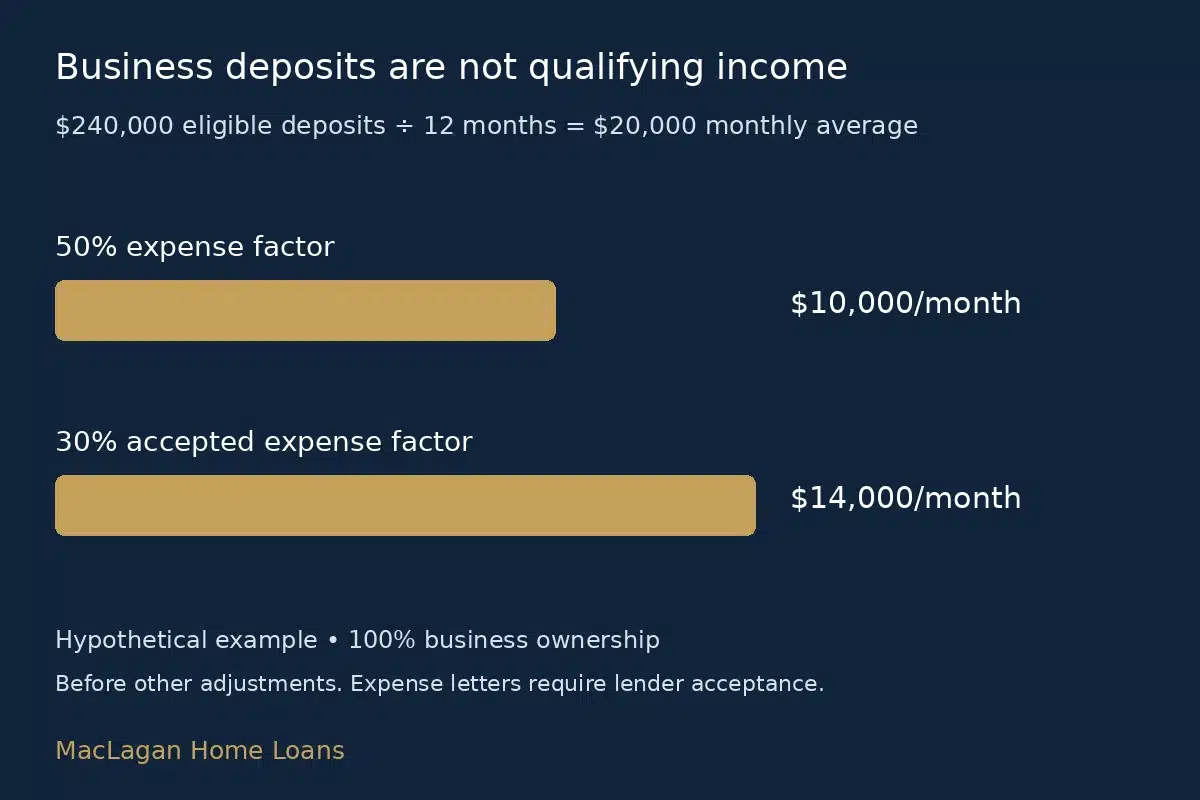
Assume a borrower owns 100% of the business and has $240,000 in eligible deposits over 12 months. The monthly average is $20,000. With a 50% expense factor, the preliminary monthly income is $10,000. With a lender accepted 30% expense factor, it becomes $14,000.
Those figures illustrate income analysis only. They assume the deposit total is already verified and there are no additional ownership or underwriting adjustments. Neither result establishes approval or determines the line amount by itself.
The higher income figure can improve the debt to income calculation, but it does not change the borrower’s actual business expenses or create extra household cash. Start with accurate records and an affordable repayment plan.
What else must you qualify for besides income?
A bank statement HELOC still requires review of credit, mortgage history, debts, available equity, property eligibility, and the proposed payment. Income documentation is one part of the application. A different income method does not waive the rest of the lender’s rules.
Combined loan to value describes the total financing against the home compared with the lender’s accepted value. Ask whether the lender counts the entire HELOC limit, other open credit lines, and existing liens when setting the maximum. Equity shown on an online estimate is not an approved borrowing amount.
The lender may also use a qualifying payment that differs from an initial interest only payment. Confirm the debt to income limit and qualifying payment method before relying on a preliminary estimate. Our HELOC options page explains the broader financing choices.
Documents to gather before applying
Start with complete statements for the accounts that actually receive business income. Include every page and avoid substituting selected transaction screenshots. The lender may ask for additional records after reviewing the file.
Gather identification, at least 12 months of personal or business bank statements, proof of business ownership and operating history, your current mortgage statement, homeowners insurance information, and details of any other liens. Have explanations and source records ready for unusual deposits. Ask whether a current profit and loss statement, business statements supporting personal deposits, or a CPA expense letter will be needed.
Also write down how much you need, what you will use it for, when you need it, and when you expect to repay it. This helps us compare a reusable credit line with a loan for a fixed amount. Do not assume that a bank statement HELOAN or refinance follows the same documentation rules as a HELOC.
When would a HELOAN or cash out refinance be a better fit?
I look more closely at a HELOAN or cash out refinance when a borrower expects to carry the balance for a longer period rather than repeatedly borrow and repay. The better fit depends on actual costs, available loan terms, and the borrower’s plan. A longer borrowing period does not automatically make one product cheaper.
A HELOAN provides a lump sum without automatic redraw. A HELOC can allow repeated borrowing during its draw period, subject to the agreement. The CFPB’s comparison of home equity loans and lines explains this distinction. Confirm whether the actual offer has a fixed or adjustable rate.
A second lien HELOC can preserve your existing first mortgage. A first lien HELOC does not preserve an existing first mortgage in that position. If we are comparing new first mortgage options, I still review the full cost rather than assume a cash out refinance must be cheaper.
For rental property financing, our DSCR equity financing comparison covers a separate qualification path. Do not apply rental cash flow rules to a HELOC secured by your primary residence.
Comparing the combined borrowing cost
When you keep the first mortgage and add a HELOC, I compare both loans against the proposed replacement mortgage. A balance weighted combined rate is a starting point: multiply each outstanding balance by its interest rate, add those results, and divide by the total borrowed balance. Do not take a simple average of the two rates.
Use the amount actually drawn for a current interest cost comparison, not an unused credit limit. The lender may use a different amount for underwriting. A combined rate is not an APR and does not include all fees, amortization, future draws, or future rate changes.
Compare the same net cash received over the same planned borrowing period. Review upfront charges, required monthly payments, principal still owed at the end of that period, and payoff terms. A smaller payment can reflect slower repayment rather than lower overall cost. Keep the existing mortgage’s remaining term in the comparison rather than judging only a newly extended payment schedule.
Terms to check before opening a line
Read the required initial draw, ongoing fees, draw period, repayment schedule, and any early closure charges. A substantial mandatory draw can make a HELOC less suitable if you only need a small amount immediately.
The CFPB’s HELOC overview explains that rates are usually variable, payments can increase, and access to more credit can be restricted. Review how you would handle a higher payment or a period when you cannot draw additional funds. Your home secures the debt, so failing to repay can put it at risk.
If your business has seasonal income, build the repayment plan around slower months as well as strong ones. Borrowing capacity is not a substitute for an operating reserve, and a hoped for refinance is not a guaranteed exit.
How do you prepare for a self employed HELOC review?
Begin with your actual cash need, then review the income records and existing mortgage before choosing a product. The goal is to compare financing that fits both lender requirements and your repayment plan.
- Define the amount needed and whether it will be borrowed at once or in stages.
- Gather complete statements and identify unusual deposits or transfers.
- Review the income method, business expenses, and ownership with the loan officer.
- Compare eligible HELOC, HELOAN, and refinance terms using the same net proceeds and time frame.
- Confirm the payment, required draw, fees, and backup repayment plan before committing.
Frequently asked questions
Can I get a bank statement HELOC without using tax returns to qualify?
Some programs use eligible bank statement deposits instead of tax returns for the income calculation. The lender still requires documentation and must approve your credit, debts, property, equity, and income history.
Do bank statement HELOCs have a debt to income limit?
They can. A bank statement program changes how qualifying income is calculated; it does not automatically eliminate debt to income requirements. Confirm the limit and payment calculation with the specific lender.
Will a CPA expense letter guarantee a larger HELOC?
No. A lender accepted letter may support a lower expense factor and higher qualifying income, but equity, credit, debts, and other program limits can still restrict the line amount.
Can I keep my existing mortgage with a bank statement HELOC?
Only if the program permits the HELOC in second lien position and the loan meets its requirements. Some HELOCs require first lien position, so confirm this before comparing offers.
Can I borrow the money again after paying down the HELOC?
Generally, repaid principal can restore available credit during the draw period if the line remains open and available under its terms. Fees, minimum draws, credit restrictions, and the end of the draw period can limit that flexibility.
Explore Your Self Employed HELOC Options
Have home equity but tax returns that do not reflect your business cash flow? MacLagan Home Loans can review your income documentation and compare eligible HELOC, HELOAN, and refinance options around your goals. Bring your current mortgage details and complete bank statements so we can discuss the next step.
Book a CallEducational information, not a loan commitment or guarantee of approval or savings. Program requirements and availability vary by lender, borrower, property, and location. Examples are hypothetical. Your home secures the financing.

ABOUT THE AUTHOR
Alex MacLagan, Loan Officer
NMLS #1912744
Alex MacLagan is a mortgage loan officer with MacLagan Home Loans. Known to his clients as “Alex The Mortgage Doctor,” he works with first time buyers, move up buyers, self employed business owners, and real estate investors across Chicagoland and the north and northwest suburbs. Before lending, Alex spent years on the investing side of real estate with hands on experience across 100+ flips and rental properties, which shapes how he structures financing for clients today. When he’s not writing about mortgages or working with clients, you’ll find him with his fiancée and their dog.